Choosing Between General and Paediatric First Aid
First Aid Safely
First Aid Training Courses
https://firstaidsafely.blogspot.com/2026/09/blog-post.html
Table of Contents
- How to Decide Between General and Paediatric First Aid
- What General First Aid Covers
- What Paediatric First Aid Covers
- Quick Decision Checklist
- PHECC First Aid Requirements Explained
- Paediatric First Aid Course Duration and Delivery Options
- Workplace First Aid Compliance Ireland: Choosing the Right Course
- Common Mistakes When Choosing a First Aid Course
- Conclusion
- Frequently Asked Questions
Last Updated: September 16, 2026
How to Decide Between General and Paediatric First Aid
Choosing between general and paediatric first aid comes down to one question: who will you actually treat? General first aid trains you to respond to adolescents and adults, while paediatric first aid focuses on infants and children under 18. At FIRST AID SAFELY, we see this decision trip up more workplace managers than any other part of compliance planning, because the wrong course leaves a genuine gap in your emergency response.
The stakes are higher than a certificate on a wall. A child's airway, choking response and CPR ratios differ from an adult's, and a general course will not prepare you for them. Below, we break down who each course suits, what each covers, and how to match the right training to your setting.
What General First Aid Covers
General first aid prepares you to respond to adolescents and adults in day-to-day emergencies. It is the standard course for most workplaces, sports clubs with adult members, and community settings.
Core content typically includes:
- Adult CPR and safe use of an automated external defibrillator (AED)
- Recovery position and managing an unresponsive casualty
- Choking response for adults
- Bleeding control, wound care and burns
- Recognising heart attack, stroke and seizure
- Incident assessment and calling emergency services
The focus is the adult casualty. Where children are mentioned at all, it is usually brief, which is exactly why general first aid is a poor fit for a creche, primary school or any setting built around young children.
What Paediatric First Aid Covers
Paediatric first aid is training focused specifically on infants and children. It teaches you to recognise and respond to the emergencies most likely to affect young people, using techniques and ratios suited to smaller bodies.
Typical paediatric content includes:
- Infant and child CPR with age-appropriate compression depth and ratios
- Choking response for infants and for children
- Febrile seizures and childhood illness recognition
- Managing burns, bleeding and head injuries in children
- Sudden infant death syndrome (SIDS) awareness and safe sleep guidance
- Asthma, allergic reactions and anaphylaxis in children
Why Infant and Child Response Differs
An infant's airway is far smaller and more easily obstructed than an adult's, and their bones are more fragile, so compression depth and technique must change. A rescue breath that would suit an adult can injure a baby. This is not a minor variation: it is the core reason paediatric first aid exists as a separate discipline, and why a general certificate does not cover it.
Quick Decision Checklist
If you are still unsure, work through these questions:
- Will you care for or supervise children under 18? If yes, you need paediatric training.
- Is your setting a creche, montessori, primary school or after-school club? Paediatric is the correct choice.
- Do you work mainly with adults in an office, warehouse or retail unit? General first aid fits.
- Do you work with both adults and children? You may need both certifications.
- Are you a sports club? Match the course to your members: adult teams need general, underage teams need paediatric.
PHECC First Aid Requirements Explained
The Pre-Hospital Emergency Care Council (PHECC) is the regulator that sets the recognised standard for first aid training and certification in this country. A course delivered by a PHECC instructor and examiner carries a certification that holds up under inspection, which matters when an auditor asks to see your training records.
This is where cheap online certificates often fall short. If a provider is not delivering to the recognised standard, the certificate may not satisfy a workplace inspection, and you will be paying for training twice. Always confirm your provider's credentials before booking.
Paediatric First Aid Course Duration and Delivery Options
Paediatric first aid course duration typically runs longer than a basic general course because of the extra content on infant and child response. Exact hours depend on the provider and the level of certification you need.
Delivery is usually available in two formats:
- Classroom: face-to-face training, ideal for hands-on CPR and choking practice.
- Blended learning: a portion completed online, with practical assessment in person. This suits teams spread across multiple sites or with clashing schedules.
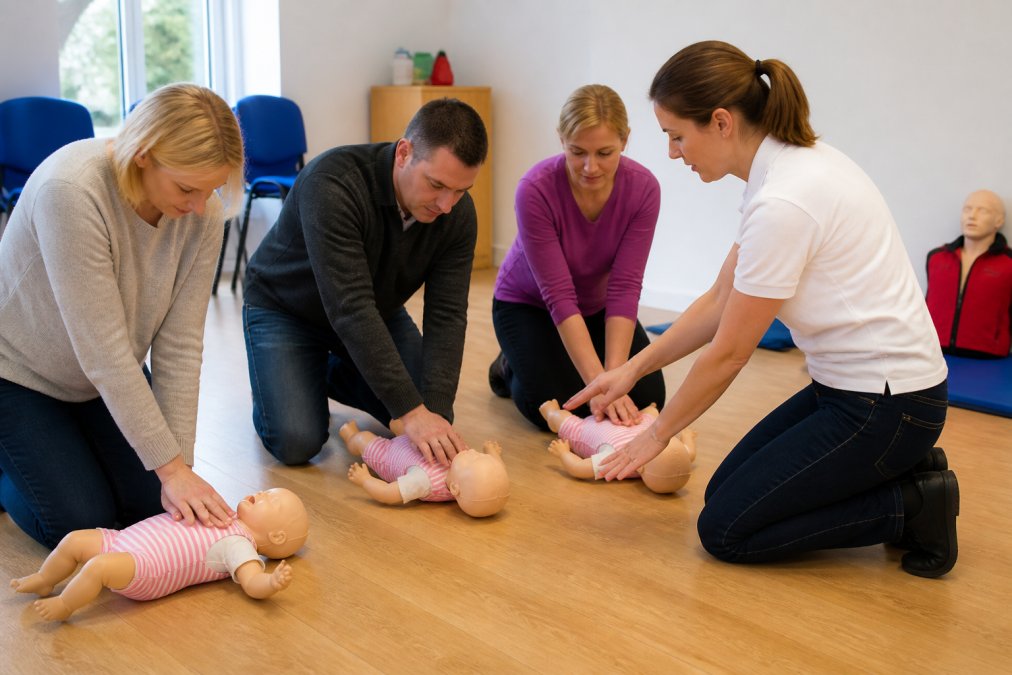
For HR managers coordinating staff across several locations, blended delivery removes the logistics headache of gathering everyone in one room on one date.
Workplace First Aid Compliance Ireland: Choosing the Right Course
Workplace first aid compliance in this country is not a box you tick once. Employers have a duty to provide adequate first aid provision, and the course you choose must match the risks and the people in your setting. A primary school that trains staff in general first aid only has a gap; a warehouse that trains everyone in paediatric first aid has the wrong skill for its actual risk.
Match the course to the environment:
| Setting | Recommended Course | Why |
|---|---|---|
| Office, retail, warehouse | General first aid | Adult casualties are the primary risk |
| Creche, montessori, primary school | Paediatric first aid | Children under 18 are in your care |
| Sports club (adult teams) | General or sports first aid | Adult members, activity-specific risks |
| Sports club (underage teams) | Paediatric first aid | Young players need age-appropriate response |
| Mixed setting (adults and children) | Both certifications | No single course covers both fully |
FIRST AID SAFELY delivers general, paediatric and sports first aid courses led by a qualified PHECC instructor and examiner, with classroom and blended options, so the course fits your setting rather than the other way around.
Common Mistakes When Choosing a First Aid Course
The single biggest mistake is choosing on price alone. A cheaper general course that does not cover children is not a bargain if your setting is full of them.
Other frequent errors:
- Assuming one certificate covers every scenario, including infant emergencies
- Letting certificates lapse because no one tracks renewal dates
- Booking a course that does not meet the recognised standard, then failing inspection
- Training only one staff member when cover is needed across shifts
Conclusion
The right course is the one that matches the people you are responsible for. Get that wrong and you carry a compliance gap and a genuine safety risk at the same time. FIRST AID SAFELY delivers general, paediatric and sports first aid led by a qualified PHECC instructor and examiner, with blended learning options for teams across multiple sites and certificates issued on completion. Get started with FIRST AID SAFELY and put the correct, compliant training in place.
Frequently Asked Questions
What is the main difference between general and paediatric first aid?
General first aid trains you to respond to adults and covers conditions like heart attacks, strokes and adult CPR. Paediatric first aid focuses on infants and children, covering child-specific choking, febrile seizures, and CPR with smaller compression depths and rescue breaths. A general course rarely includes infant CPR, so if your role involves children, a paediatric course is the safer choice.
Does a general first aid course cover infant CPR?
Most general first aid courses focus on adult CPR and do not include infant or child CPR. If your workplace, school or club has children on site, you need a paediatric first aid course that specifically covers infant and child resuscitation. Check the course syllabus before booking, and ask whether infant CPR is assessed or only demonstrated.
Which first aid course is required under the Safety, Health and Welfare at Work Act?
The Safety, Health and Welfare at Work Act 2005 requires employers to provide adequate first aid arrangements, but it does not name one specific course. In practice, workplace first aid compliance Ireland relies on general first aid training for adult-heavy workplaces. If children are regularly on site, a paediatric course is the more appropriate choice for those staff.
Can a paediatric first aid course be used for workplace compliance?
Yes, in many cases. A paediatric first aid certificate can support workplace compliance where children are present, such as schools, creches and sports clubs. However, for adult-heavy workplaces, a general first aid course is usually the better fit. Employers should match the course to the people actually on site, not just tick a box.


Comments
Post a Comment