Benefits of Paediatric First Aid Training for Parents
Table of Contents
- Why Paediatric First Aid Training Matters for Parents
- What Do You Learn on a Paediatric First Aid Course?
- Baby and Child CPR Training: The Skill Parents Hope Never to Use
- First Aid for Choking in Babies and Children
- Paediatric First Aid Course Duration, Format and Certification
- When to Call Emergency Services and What to Tell the Dispatcher
- What Parents Should Keep in a Home and Travel First Aid Kit
- Conclusion
- Frequently Asked Questions
Last Updated: October 17, 2026
Why Paediatric First Aid Training Matters for Parents
A 2026 study of a first-aid programme for parents of children aged 0-6 found significant improvements in parents' first-aid knowledge and practical skills after training, according to research published in ScienceDirect. That is the case for paediatric first aid in one sentence: it turns panic into a plan. The gap most parents carry is not care or instinct. It is technique, and technique can be taught in a day.
Below, we break down exactly what a paediatric first aid course covers, how long it takes, and the skills that matter most when a child is injured or unwell.
What Do You Learn on a Paediatric First Aid Course?
A paediatric first aid course teaches parents and carers to recognise and respond to common childhood emergencies before professional help arrives. Core content covers CPR, choking, bleeding, burns, seizures and signs of serious illness. The aim is not to replace a clinician but to buy time, safely and correctly.
Expect hands-on practice, not just slides. Courses often run through scenario work so you rehearse the response rather than memorise it.
Age-Specific Differences: Babies, Toddlers and Older Children
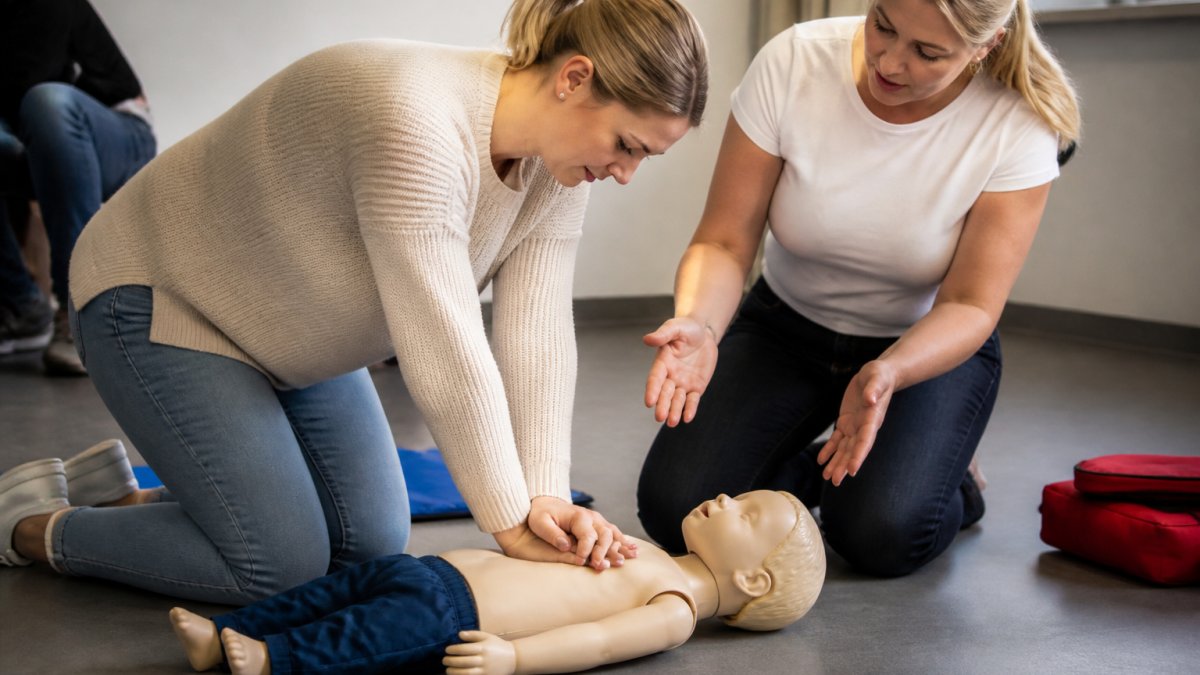
The same emergency needs different handling depending on the child's age. Infant CPR uses two fingers on the centre of the chest; for a child, you use the heel of one hand. Choking back blows and abdominal thrusts differ for babies under one. A course should make these distinctions explicit, because a technique learned for an adult can be wrong for a six-month-old.
Baby and Child CPR Training: The Skill Parents Hope Never to Use
Baby and child CPR training teaches the compression-to-breath ratio, hand placement and rescue breath technique for infants and children, so a parent can act in the first critical minutes. Research from Frontiers in Pediatrics notes that parental first-aid knowledge is important for responding to paediatric emergencies and can help reduce injury severity. CPR is the skill you rehearse and hope to forget.
First Aid for Choking in Babies and Children
First aid for choking in babies and children depends on age and on whether the child can cough. If a baby is coughing effectively, let them clear it. If the airway is obstructed, use back blows and, where appropriate, chest or abdominal thrusts as taught on your course. Never put your fingers blindly into a child's mouth, as this can push the object further in.
Paediatric First Aid Course Duration, Format and Certification
Course length is the first thing most parents ask, and the honest answer is that it depends on the awarding body and the depth of the syllabus. As a working guide, a single-day classroom course typically runs six to eight contact hours, while a two-day paediatric course runs around twelve to sixteen hours and includes a wider practical assessment. Blended formats usually split this into two to four hours of online theory followed by a half-day of in-person practice and assessment. Ask any provider for the total guided-learning hours, not just the classroom hours, because the online component is where the knowledge content sits.
What matters more than the clock is what is assessed. A credible course should include a practical CPR and choking assessment on an infant and a child manikin, not a multiple-choice quiz alone. If you cannot fail the practical element, you have not been assessed on the skill that matters.
| Format | Typical Structure | Contact Hours | Best For |
|---|---|---|---|
| Classroom (one day) | Hands-on throughout, practical assessment | 6-8 | Parents who want maximum manikin time |
| Classroom (two day) | Broader syllabus, more scenario work | 12-16 | Childminders, crèche staff, carers |
| Blended | Online theory plus half-day practical | 2-4 online + 4 in person | Busy parents and shift workers |
| On-site | Delivered at your location | Matches chosen format | Schools, crèches, clubs and community groups |
Certification and renewal are the parts parents most often overlook. Certification follows successful completion of the practical assessment, and most awarding bodies recommend refreshing every two to three years, with an annual skills update in between. Skills decay is real: compression depth and rate drift within months if unrehearsed, which is why a short refresher is worth more than a certificate on a shelf. Check that the certificate names the awarding body and the syllabus covered, and keep a note of the expiry date.
Our courses are delivered by a qualified PHECC instructor and examiner, with classroom and blended learning available, and certificates issued on completion. PHECC, the Pre-Hospital Emergency Care Council, is the statutory regulator for pre-hospital emergency care practitioners, so a course led by a PHECC-qualified instructor and examiner is assessed against a recognised standard.
When to Call Emergency Services and What to Tell the Dispatcher
Most parents hesitate not because they do not know the number but because they are unsure whether the situation is serious enough to call. The safer rule is to call early and let the dispatcher triage. In Ireland, 112 and 999 both connect to the emergency services, and 112 is the single European emergency number; either will reach ambulance control. Do not drive a seriously unwell child to hospital yourself if you are unsure, an ambulance can begin treatment en route.
Call immediately if a child is unresponsive or not breathing normally, is struggling to breathe or making grunting, sucking or tracheal noises, has blue or grey lips, has a seizure lasting more than five minutes or a first-ever seizure, has a serious burn or a wound that will not stop bleeding, has swallowed a button battery or magnetic toy, or has a head injury with vomiting, drowsiness or confusion. For babies under one, call sooner rather than later: a fever in a young infant, poor feeding, a sunken fontanelle or unusual floppiness warrants urgent assessment even if the child does not look dramatically ill.
When you call, the dispatcher needs a short, ordered script. Give your exact location first, an Eircode is ideal, plus a landmark and whether access is clear for an ambulance. Then give the child's age, what happened, whether the child is breathing and whether they are responsive. Stay on the line, put the phone on speaker, and follow the dispatcher's instructions; they can talk you through CPR compressions or choking back blows in real time.
While you wait, keep the child warm, do not give food or drink, do not move a child with a suspected spinal injury unless they are in danger, and have someone wait at the entrance to guide the crew in. If the child becomes unresponsive and is not breathing normally, start CPR and continue until the ambulance arrives or the child recovers.
What Parents Should Keep in a Home and Travel First Aid Kit
A home and travel first aid kit should cover the injuries you are most likely to meet: cuts, grazes, burns and sprains. Keep it stocked and check expiry dates twice a year.
- Adhesive plasters in assorted sizes
- Sterile gauze and a roll of bandage
- Antiseptic wipes
- Digital thermometer
- Burn dressing or cling film for scalds
- Tweezers and blunt-nosed scissors
- Disposable gloves
- A card with emergency numbers
Conclusion
No parent can prevent every accident, but you can be ready for one. If your paediatric first aid knowledge is rusty or never existed, book a course and close the gap. FIRST AID SAFELY delivers paediatric first aid training led by a qualified PHECC instructor and examiner, with classroom and blended learning options and certificates on completion.
Frequently Asked Questions
What do you learn on a paediatric first aid course?
A paediatric first aid course covers the emergencies most likely to affect babies and young children: infant and child CPR, choking and airway obstruction, bleeding and wound management, burns and scalds, seizures, nosebleeds, sprains and suspected fractures. You also learn how to assess a child's condition, recognise signs of distress and decide when to call emergency services. Courses combine knowledge with hands-on practice on manikins, so you leave having physically performed the techniques rather than just read about them. Training also covers age-specific differences, because a technique that suits a toddler may not suit a newborn.
Does paediatric first aid training cover CPR for babies and children?
Yes. Baby and child CPR training is a core part of any paediatric first aid course. You learn the correct hand position and compression depth for an infant versus an older child, how to give rescue breaths, and how the ratio of compressions to breaths differs by age. The training also covers what to do if a child is unresponsive but breathing, and how to use an AED where one is available. Practising on age-appropriate manikins is what builds the muscle memory you need in a real emergency.
How often should parents refresh their paediatric first aid skills?
Most recognised first aid authorities recommend refreshing practical skills every two to three years, with annual updates if your circumstances allow. Skills fade faster than knowledge: parents often remember what to do but lose confidence in the physical technique. A short refresher session restores compression depth, choking manoeuvre positioning and the confidence to act. If your certificate has an expiry date, diarise the renewal a month ahead so you are never caught without valid certification, particularly if your role or setting requires it.
How long does a paediatric first aid course take?
Paediatric first aid course duration varies by provider and format. Short parent-focused sessions can run for a few hours, while fuller certified courses typically take one to two days. Blended learning splits the theory into online modules you complete at your own pace, followed by a shorter in-person session for the practical elements. When comparing options, check what the certificate covers and how much hands-on practice is included, not just the total hours. Ask the provider directly about duration and delivery format before booking.


Comments
Post a Comment