PHECC First Aid Training Requirements 2026: What You Need
Table of Contents
- HSA First Aid Requirements 2026: What Employers Must Know
- PHECC First Aid Training Standards and the FAR Course
- First Aid Response (FAR) Course Duration and Structure
- Workplace First Aid Needs Assessment: How Many First Aiders?
- Certification Validity, Recertification, and the 2026 Deadline Rules
- Step-by-Step: Registering for PHECC First Aid Training
- Step 1: Confirm which standard you need
- Step 2: Complete or review your needs assessment
- Step 3: Choose your delivery route
- Step 4: Verify the provider and instructor
- Step 5: Book inside the recertification window
- Step 6: Complete training and continuous assessment
- Step 7: Log the certificate the day it is issued
- What changed for 2026
- Frequently Asked Questions
Last Updated: September 28, 2026
HSA First Aid Requirements 2026: What Employers Must Know
The Health and Safety Authority requires every workplace to have adequate first aid provision, and PHECC first aid training requirements 2026 have tightened the rules around who holds a valid certificate and when it expires. This guide covers what the 2026 rules actually demand, how the FAR course is structured, and how to keep your certification cycle clean.
The core obligation has not changed. Employers must provide first aid equipment, supplies and trained personnel appropriate to the hazards of the workplace, as set out in HSA guidance on first aid at work. What has changed is enforcement. The 2026 rules mandate strict adherence to recertification windows, and missing one no longer means a short refresher. It means repeating the full initial course.
Employer vs. Employee Responsibilities
Employers carry the legal duty. That means assessing workplace hazards, deciding how many first aiders are needed, funding the training, and maintaining records that prove certification is current. The HSA does not accept a verbal assurance that someone "did a course a while back."
Employees have a narrower but real role: attending training, maintaining their skill competency, and reporting hazards or incidents. A first aider who lets certification lapse creates a compliance gap the employer owns, not the individual.
PHECC First Aid Training Standards and the FAR Course
First Aid Response (FAR) is the recognised occupational first aid standard for workplaces, delivered under the Pre Hospital Emergency Care Council's education and training standards and recognised by the Health and Safety Authority. The initial FAR course runs as a 3-day, 18-hour classroom programme, and certification is valid for 2 years (Health and Safety Authority, 2026) (First Aid).
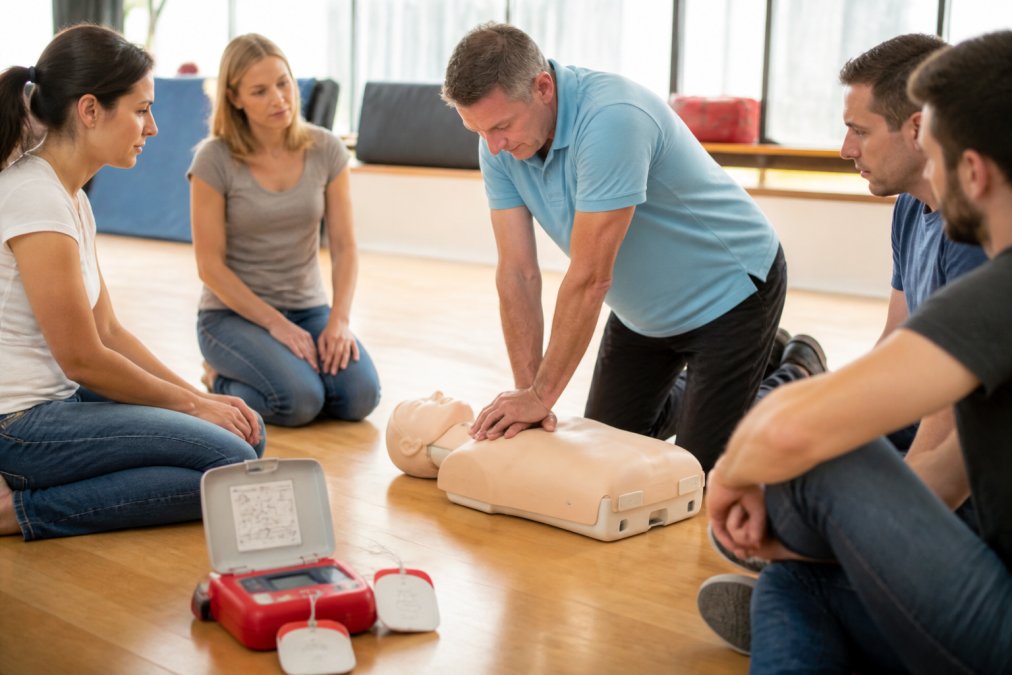
Clinical Practice Guidelines (CPGs) 2026 Updates
The Clinical Practice Guidelines set the clinical protocols every FAR course must teach, and the 2026 revisions sharpen the emphasis on early defibrillation and structured patient assessment. Trainees now work through the primary survey with more scenario-based repetition, and CPR protocols are assessed against current adult resuscitation standards rather than recalled from a manual.
First Aid Response (FAR) Course Duration and Structure
The First Aid Response (FAR) course duration is 3 days, or 18 contact hours, delivered as classroom-based theory and practical training. The course covers patient assessment, CPR protocols, use of an automated external defibrillator (AED), choking, bleeding control, burns, fractures, and medical emergencies including cardiac and stroke events.
Blended Learning vs. Classroom-Only Delivery
Blended learning splits the theory component into self-paced online modules, with practical training and assessment completed in person. It suits organisations with staff across multiple sites or shift patterns that make three consecutive classroom days impractical.
| Delivery Route | Theory Component | Practical Component | Best For |
|---|---|---|---|
| Classroom-only | 3 days in person | Included in the 18 hours | New first aiders, shift-based teams |
| Blended learning | Self-paced online | Scheduled in-person sessions | Multi-site teams, mixed schedules |
Workplace First Aid Needs Assessment: How Many First Aiders?
A workplace first aid needs assessment determines how many trained first aiders you need, based on workforce size, shift patterns, the nature of the work, and distance from emergency medical services. There is no single headcount rule that fits every site.
Work through it in this order:
- Identify the hazards each role actually carries, from desk work to machinery and chemicals.
- Map shift patterns and lone-working arrangements, because cover is needed on every shift.
- Check the site's distance from ambulance response and whether an AED is on site.
- Factor in absences and leave so you are never relying on one certificate.
- Record the assessment and review it annually or after any significant change.
Certification Validity, Recertification, and the 2026 Deadline Rules
FAR certification is valid for 2 years, and the 2026 rules require strict adherence to the recertification window. Miss it and the certificate lapses, which means the employee must repeat the full 3-day initial course rather than a shorter refresher.
Step-by-Step: Registering for PHECC First Aid Training
Most guides link to a portal and stop there. This is the actual journey a first-time learner takes, from deciding which standard applies to holding a certificate that survives an audit.
Step 1: Confirm which standard you need
First Aid Response (FAR) is the recognised occupational standard for workplaces. First Aid Essentials (FAE) is a shorter basic course for non-occupational settings and does not meet the occupational standard. If your purpose is workplace compliance, you need FAR.
Step 2: Complete or review your needs assessment
The number of places you book should come out of your workplace first aid needs assessment, not a guess. Workforce size, shift patterns, lone working, hazards and distance from emergency medical services all feed into it. Book the number the assessment produces.
Step 3: Choose your delivery route
Classroom-only runs as a 3-day, 18-hour programme. Blended learning splits the theory into self-paced online modules with the practical training and assessment completed in person. Both end at the same assessment standard, and the practical hours cannot be completed online.
Step 4: Verify the provider and instructor
Ask two questions before you pay: is the instructor a qualified PHECC instructor and examiner, and is the course mapped to the current edition of the Clinical Practice Guidelines? A provider who cannot answer both clearly is a compliance risk.
Step 5: Book inside the recertification window
This is where the 2026 rules bite. Certification is valid for 2 years, and the recertification window is not a grace period you can negotiate. Book each candidate's place so that the course is completed before their existing certificate lapses.
Step 6: Complete training and continuous assessment
Assessment is continuous across every module. Candidates must demonstrate practical skill competency, not just pass a written paper. There is no single exam to cram for.
Step 7: Log the certificate the day it is issued
Record the certificate, its 2-year expiry date, the guideline edition the course was mapped to, and the instructor or recognised institution that issued it. Set a renewal reminder 8 to 10 weeks before expiry.
What changed for 2026
If you trained under the previous rules, the practical difference is enforcement. The 2026 rules require strict adherence to the recertification window, and a lapsed certificate now means repeating the full initial course rather than a short refresher. That single change is why the booking date and the expiry date need to be managed as one continuous cycle rather than two separate events.
Frequently Asked Questions
What are the current PHECC training standards for 2026?
The Pre Hospital Emergency Care Council (PHECC) First Aid Response (FAR) standard remains the recognised benchmark for workplace first aid. It is delivered as an 18-hour classroom course, usually spread across three days, and certification stays valid for two years. Updated 2026 rules tighten the recertification window, so employers need to track expiry dates carefully. PHECC Clinical Practice Guidelines were also refreshed for 2026, which affects what learners are assessed on during practical training.
How long does a PHECC First Aid Response (FAR) certificate last?
A PHECC First Aid Response certificate is valid for two years from the date of assessment. After that, you must recertify within the designated window to keep your certification active. Missing the window under the new 2026 rules means repeating the full three-day initial course rather than a shorter refresher. Employers should log expiry dates for every certified staff member and book refresher training well before the deadline to avoid compliance gaps.
How many first aiders are required for a workplace under HSA guidelines?
The Health and Safety Authority does not set a single fixed number. Instead, employers must carry out a workplace first aid needs assessment that considers staff numbers, the nature of the work, shift patterns, and proximity to emergency services. A low-risk office with 40 staff may need one or two trained first aiders, while a high-risk manufacturing site typically needs more, distributed across shifts. The assessment should be reviewed whenever operations or staffing change.
What is the difference between OFA and FAR certification?
Occupational First Aid (OFA) was the older workplace standard. First Aid Response (FAR) replaced it as the PHECC-recognised benchmark and is now the qualification employers should look for. FAR covers patient assessment, CPR protocols, use of an Automated External Defibrillator (AED), and management of common workplace injuries. If your staff hold OFA certificates, check whether they remain valid for your needs assessment or whether upgrading to FAR is required.
Do I need a PHECC-registered instructor for workplace training?
Yes. For certification to hold up under audit, training must be delivered by a PHECC-registered instructor and examiner. This ensures the course follows approved Clinical Practice Guidelines and that assessment meets the national standard. Before booking any provider, ask for their PHECC registration details and verify them. Training delivered by unregistered providers may not be accepted as evidence of compliance if an incident or inspection occurs.
Can blended learning replace classroom-only PHECC first aid training?
Blended learning combines online theory modules with in-person practical assessment, which suits organisations with staff across multiple sites or staggered schedules. The practical elements, including CPR and AED use, must still be completed face-to-face with a registered instructor. Not every course allows a fully blended route, so confirm the delivery format meets PHECC requirements before enrolling. For many SMEs, blended delivery reduces downtime without compromising certification validity.


Comments
Post a Comment