Who Is Legally Responsible for Workplace First Aid?
Quick Summary
Employers carry the legal duty to provide adequate workplace first aid for their employees, not the individual staff member. This duty comes under the Safety, Health and Welfare at Work Act 2005 in Ireland and is enforced by the Health and Safety Authority, which expects a first aid needs assessment to guide provision.
- The duty to provide first aid sits with the employer, not the individual staff member.
- A first aid kit alone does not satisfy the employer's legal duty.
- Base the number of first aiders on the maximum number of people on site at any one time.
- Review the first aid risk assessment at least annually and after any significant change.
- Train more first aiders than the minimum so absence does not leave a gap in cover.
Table of Contents
- What the Law Requires of Employers for Workplace First Aid
- How to Carry Out a First Aid Risk Assessment in the Workplace
- Deciding the Number of First Aiders Required in the Workplace
- Workplace First Aid Kit Requirements and Equipment
- Training, Certification and Coverage for Absences and Remote Work
- Workplace First Aid Compliance Checklist: Inspection, Replenishment and Records
- Putting Your Workplace First Aid Arrangements Into Practice Now
- Frequently Asked Questions
What the Law Requires of Employers for Workplace First Aid
Last Updated: October 28, 2026
Employers in Ireland carry the legal duty to provide adequate first aid for their employees. The duty sits with the employer, not the individual staff member.
The governing framework is the Safety, Health and Welfare at Work Act 2005 and its associated regulations, which are enforced by the Health and Safety Authority (Safety, Health and Welfare at Work Act 2005). Health and Safety Authority guidance on first aid at work sets out what employers must assess and provide.
Many employers assume that a first aid kit alone satisfies the duty. It does not.
How to Carry Out a First Aid Risk Assessment in the Workplace
A first aid needs assessment is the starting point for deciding what provision your workplace requires. It asks how many people could be injured, how serious those injuries could be, and how quickly help must arrive.
What the assessment must capture
- Workforce profile, total headcount, the maximum number on site at any one time, and how many are contractors, temporary staff or agency workers.
- Work patterns, shift rotas, night work, lone working, remote and hybrid arrangements, and the times of day when cover is thinnest.
- Hazards by activity and location, machinery, work at height, chemicals, manual handling, vehicles, electrical work, kitchen and catering areas, and any location away from the main premises.
- Likely severity and frequency, for each hazard, whether the realistic outcome is a minor injury, a serious injury or a life-threatening event, and how often people are exposed.
- Incident history, review accident and incident records for the past 12 to 24 months to see what actually happens, not just what could happen.
- Access and response times, how quickly an ambulance could reach each work area, whether the site is rural or urban, and whether access is restricted by gates, floors or security.
- Vulnerable workers, new and young workers, pregnant employees, staff with disabilities or known health conditions, and anyone working alone.
Turning the assessment into provision decisions
Each finding should map to a decision. A workshop with rotating machinery and 40 staff across two shifts needs a different answer from a 15-person office. Record the link explicitly: hazard identified, people exposed, severity, and the provision chosen in response, trained first aiders, kit type and location, emergency arrangements, and any additional equipment such as an automated external defibrillator where the assessment indicates one.
A reusable assessment template
A simple table works better than a long narrative. Use columns for: location or activity; hazards; number exposed; likely severity; existing controls; first aid provision required; responsible person; review date. Keep one row per activity or area so that changes are easy to spot and update.
When to review
Review the assessment at least annually, and sooner whenever there is a change: new premises, new equipment, a change in shift patterns, a rise or fall in headcount, a serious incident, or a move to remote or hybrid working. Record the review date and the reason for any change, so the document shows a live process rather than a one-off exercise.
Deciding the Number of First Aiders Required in the Workplace
There is no single fixed ratio for Irish workplaces. The number of trained first aiders depends on your workforce size, the hazards identified in your assessment, and how your staff are spread across shifts and sites. Lower-risk offices generally need fewer trained personnel than workshops or sites with heavy machinery, and the assessment, not a rule of thumb, is the evidence base for the number you choose.
Start from the maximum, not the average
Base your calculation on the maximum number of people on site at any one time, not the total headcount. A site with 60 employees where only 20 are present on any shift needs cover for 20, plus a margin for absences. Record both figures in the assessment so the reasoning is visible.
Test whether cover actually works
- Breaks and meal relief, is a trained first aider present during every break period, or does cover disappear when the nominated person steps away?
- Annual leave and sickness, if your only trained first aider is on leave, who covers? Train more people than the minimum so that absence does not leave a gap.
- Night and early shifts, are trained first aiders distributed across shifts, or concentrated on days?
- Lone workers, does a lone worker have a means of summoning help, a check-in arrangement, and a named person responsible for responding?
- Contractors and temporary staff, are they covered by your arrangements while on site, and do they know who the first aiders are?
- Multiple sites, does each site have its own provision, or is cover assumed from a neighbouring location that may not be staffed?
- Remote and hybrid workers, what is the plan when someone is injured while working from home or off site?
Match training to the work
At FIRST AID SAFELY, our first aid courses are delivered by a qualified PHECC instructor and examiner, with blended learning options available. Pricing depends on quantity, dates and delivery; contact us for current prices or a quote.
Our general first aid courses are described on our course overview, and upcoming course dates are listed for teams ready to schedule training.
Record the decision
Write down the number of first aiders chosen, the shifts and locations they cover, the assumptions behind the figure, and the review date. If you cannot explain how you reached the number, the arrangement is hard to defend on inspection. Review the number whenever the workforce, shift patterns or premises change, and keep the previous versions so the history is traceable.
The number of trained first aiders depends on several factors, and the article points to the checks that test whether cover actually works.
| Check | What to confirm |
|---|---|
| Maximum on site | Base the count on people present at one time, not total headcount |
| Breaks and meal relief | A trained first aider is present during every break |
| Annual leave and sickness | Train more people than the minimum so absence leaves no gap |
| Night and early shifts | Trained first aiders are spread across shifts, not only days |
| Lone workers | A means to summon help and a named responder |
| Contractors and temporary staff | Covered by arrangements and know who the first aiders are |
| Multiple sites | Each site has its own provision, not assumed cover |
| Remote and hybrid workers | A plan exists for injury while working from home or off site |
Workplace First Aid Kit Requirements and Equipment
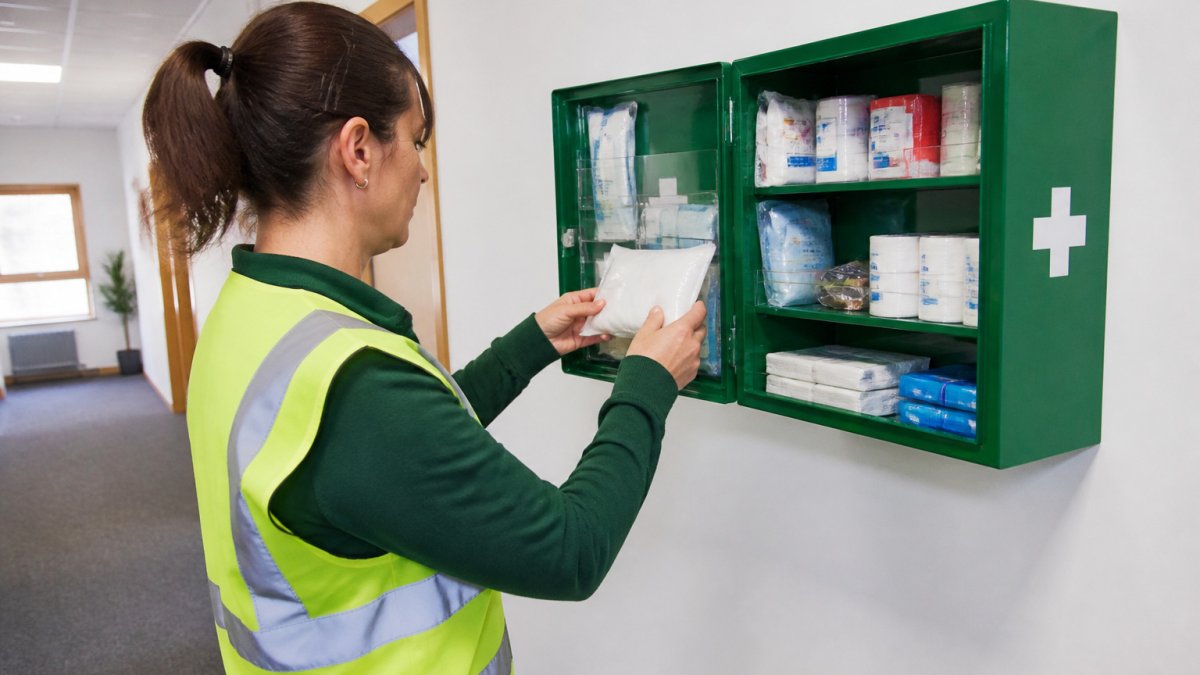
Expired or depleted items are a frequent inspection finding. Build replenishment into your routine rather than waiting for a problem to surface.
Training, Certification and Coverage for Absences and Remote Work
At FIRST AID SAFELY, our general first aid courses are delivered by a PHECC-registered instructor and examiner, with blended learning available for teams spread across sites. Pricing depends on group size, course dates and delivery format, so contact us for a quote in euro.
Our general first aid courses are described on our course overview, and upcoming course dates are listed for teams ready to schedule training.
Workplace First Aid Compliance Checklist: Inspection, Replenishment and Records
- Risk assessment reviewed in the last 12 months or after any change
- Number of trained first aiders matches the assessment
- Certificates in date, with renewal dates tracked
- Kit checked and restocked on a fixed schedule
- Emergency procedures and contact details displayed and current
- Records of checks, training and incidents kept and retrievable
- Cover arranged for absences, shifts and remote staff
Putting Your Workplace First Aid Arrangements Into Practice Now
Reach out to FIRST AID SAFELY for guidance on your workplace provision.
Frequently Asked Questions
What are the legal responsibilities for workplace first aid provision?
Employers in Ireland have a duty under health and safety law to provide adequate and appropriate first aid equipment, facilities and trained personnel so that employees who are injured or taken ill at work receive immediate assistance. The duty is based on the outcome of a risk assessment, which considers the workplace hazards, the workforce size and the work patterns. Employers must also inform employees of the arrangements, display relevant contact information and review provision regularly as circumstances change.
What are the minimum first aid provisions required for any workplace?
Every workplace needs a first aid kit, access to someone trained to give first aid, and clear information on the arrangements for emergencies. The exact level depends on the first aid risk assessment. Low-risk offices may need a basic kit and an appointed person, while higher-risk sites need more trained first aiders and additional specialised equipment. Records of the assessment and the provision made should be kept.
How should an employer decide how many first aiders are needed?
The number of first aiders depends on the workplace hazards, the number of employees, the shift patterns and how spread out the staff are. A practical approach is to start from the risk assessment, then consider whether first aid cover is available during all working hours, including breaks, lunch periods and lone working. Larger or higher-risk sites will need more trained people than a small, low-risk office. Review the number when staff numbers or work patterns change.
How often should workplace first aid arrangements be reviewed?
Arrangements should be reviewed at least annually and whenever there is a significant change, such as a new site, new hazards, a change in workforce size, or after an incident that shows a gap. Inspect first aid kits regularly, check expiry dates and replace used items promptly. Keep a simple record of each review so you can show how the provision was maintained over time.
Does a first aid risk assessment need to be written down?
Keeping a written record is the safest approach, especially for a business with several employees. The record should identify the hazards, describe who could be affected, state the first aid provision in place and note when the assessment will be reviewed. A written assessment also makes it easier to demonstrate compliance during an inspection or audit.


Comments
Post a Comment