PHECC Certified First Aid Training: 2026 Provider Guide
Table of Contents
- What PHECC Certification Means for Your Workplace
- First Aid Response (FAR) Course Duration and Structure
- Workplace First Aid Requirements HSA Expects You to Meet
- PHECC Certified First Aid Training Providers Compared
- PHECC FAR Refresher Course: Keeping Certification Valid
- How to Verify a PHECC Certification in 4 Steps
- Employer Compliance Checklist and Common Pitfalls
- Frequently Asked Questions
Last Updated: September 30, 2026
What PHECC Certification Means for Your Workplace
PHECC certified first aid training is the recognised standard for workplace first aid compliance, delivered under the Pre-Hospital Emergency Care Council's national framework. This guide from FIRST AID SAFELY covers what the certification includes, which qualification you need, and how to keep it valid.
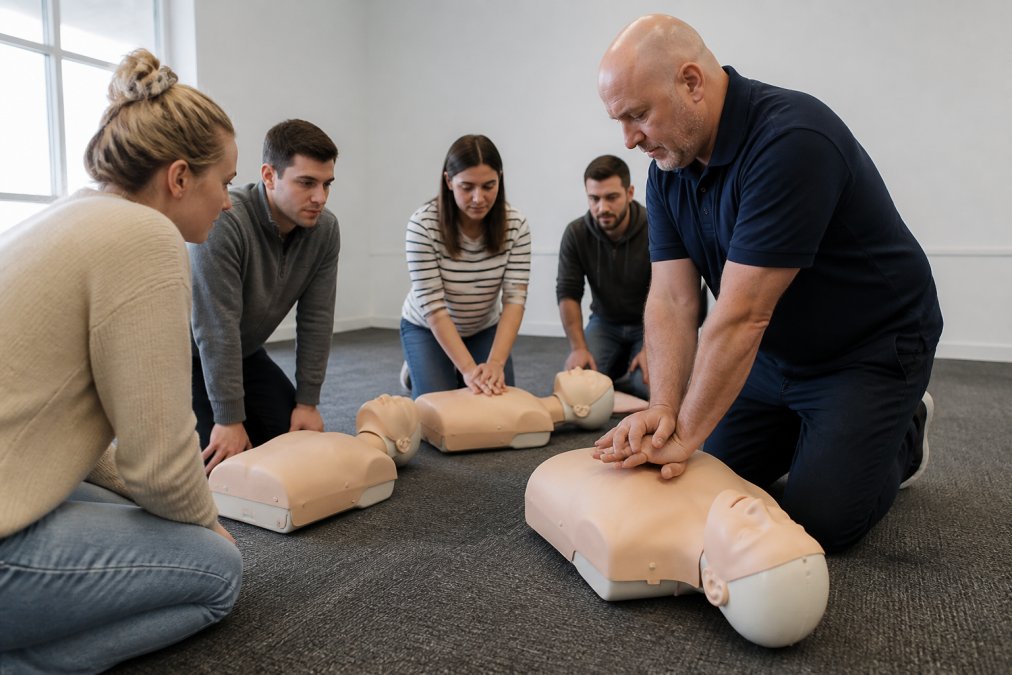
The Pre-Hospital Emergency Care Council sets the training standards that Irish workplaces are measured against, and it launched Responder Level Digital Certification on 1st March 2025 to modernise how qualifications are verified (PHECC Responder Level Digital Certificates).
FAR vs CFR: Which Qualification Do You Actually Need?
First Aid Response (FAR) is the full workplace qualification. Cardiac First Response (CFR) is a shorter course covering CPR and defibrillator use only.
| Qualification | Duration | Best For | Certification Validity |
|---|---|---|---|
| FAR | 3 days, 18 hours minimum | Designated workplace first aiders | 2 years |
| CFR | A few hours | Staff needing CPR and AED skills only | 2 years |
| First Aid Essentials | 1 day | Low-risk settings, awareness level | Varies |
First Aid Response (FAR) Course Duration and Structure
The FAR course runs a minimum of 18 hours across 3 days, fixed by the PHECC standard rather than individual providers. What varies is delivery and how assessment is staged.
-
Day 1: Scene safety, patient assessment, the chain of survival, and initial CPR and defibrillator (AED) skills practice.
-
Day 2: Choking, bleeding control, shock management, burns, fractures, and medical emergencies such as stroke, cardiac events, asthma, and anaphylaxis.
-
Day 3: Consolidation, scenario-based practice, record keeping and handover to emergency services, then formal assessment.
-
Scene safety and patient assessment
-
CPR and defibrillator use
-
Choking, bleeding and shock management
-
Burns, fractures and medical emergencies
-
Record keeping and handover to emergency services
Assessment and Examination Process
Assessment combines practical skills testing with a written or multiple-choice exam. Candidates must pass both elements to receive certification.
FAR vs CFR vs Other Qualifications: Choosing Correctly
Before booking, be clear on which qualification your risk assessment calls for. FAR and CFR are the two most commonly confused.
| Qualification | Duration | Best For | Certification Validity |
|---|---|---|---|
| FAR | 3 days, 18 hours minimum | Designated workplace first aiders | 2 years |
| CFR | A few hours | Staff needing CPR and AED skills only | 2 years |
| First Aid Essentials | 1 day | Low-risk settings, awareness level | Varies |
Workplace First Aid Requirements HSA Expects You to Meet
The Health and Safety Authority expects every employer to assess first aid needs based on hazards, workforce size, and proximity to emergency services. No single number applies to every business.
PHECC Certified First Aid Training Providers Compared
Provider choice affects cost, scheduling, and sector fit. Price is the easiest thing to compare and the least useful alone, two providers can quote the same figure and deliver very different practical instruction.
- Candidate-to-instructor ratio. Lower ratios mean more hands-on repetitions per candidate, which is the strongest predictor of passing the practical assessment.
- Who assesses. Independent assessment by a qualified PHECC examiner is a quality signal. Self-assessment by the same instructor who taught the course is permitted but offers less assurance.
- Delivery format. Classroom, blended, or on-site at your premises. On-site removes travel time and lets instructors work with your actual environment and equipment.
- Sector experience. A provider who regularly trains construction, healthcare, or childcare teams will bring relevant scenarios rather than generic ones.
- Certificate issuance and verification. Confirm certificates are issued promptly and are verifiable through the PHECC digital certification service.
- Refresher pathway. Ask how the provider handles the 2-year renewal, a clear refresher route avoids scrambling when certificates near expiry.
FIRST AID SAFELY: Instructor-Led and Blended Options
FIRST AID SAFELY combines PHECC instructor and examiner-led delivery with flexible formats. Courses are built around Irish Health and Safety legislation, not a generic international syllabus.
Qualtec, Order of Malta and Other Recognised Providers
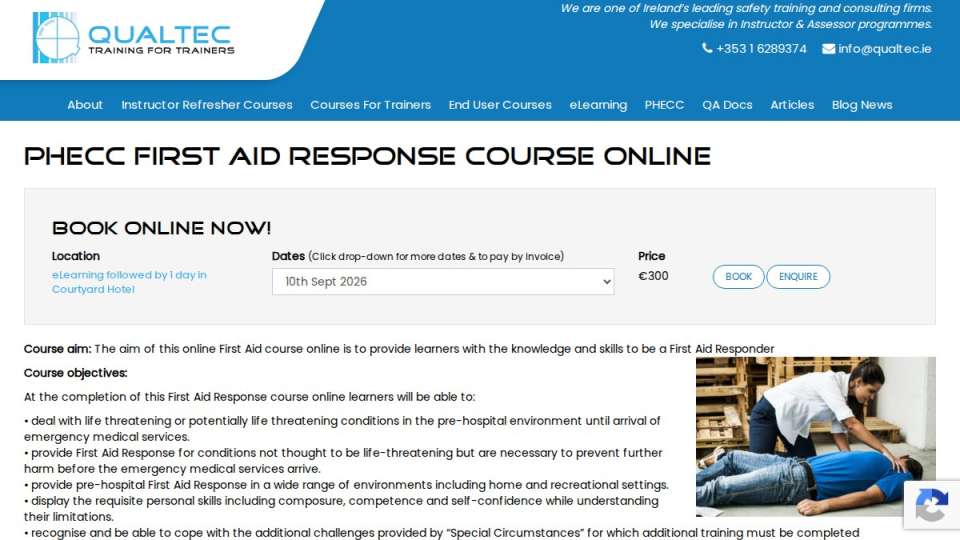
| Provider | Format | Pricing | Best For |
|---|---|---|---|
| FIRST AID SAFELY | Instructor-led, blended, on-site | Quote on request | Employers needing flexible, legislation-aligned training |
| Qualtec | Instructor-led | On request | Formal workplace certification |
| Order of Malta Ireland | Instructor-led, on-site | On request | Organisations wanting joint certification |
| Safety Training Ireland | Small-group | €187.50 per person | Teams wanting published pricing |
| Holland Safety | On-site, construction focus | On request | High-risk construction sites |
What to Ask Before You Book
These questions separate providers more reliably than a price list:
- What is your candidate-to-instructor ratio for this course? Anything above roughly 12:1 starts to reduce hands-on time per candidate.
- Who conducts the practical assessment? Look for an independent PHECC examiner.
- Can you deliver on-site at our premises? Useful where staff can't easily travel or where you want training in your own environment.
- How are certificates issued, and can we verify them digitally? Confirm the certificate will be verifiable through the PHECC service.
- What is your refresher process, and how far in advance should we book? Refresher slots fill up, so a provider with a clear renewal pathway saves administrative headaches.
PHECC FAR Refresher Course: Keeping Certification Valid
FAR certification is valid for 2 years, after which re-certification is required (Holland Safety on certification validity). The refresher is shorter than the initial course but still requires practical assessment.
How to Verify a PHECC Certification in 4 Steps
PHECC certification can be verified digitally following the rollout of Responder Level Digital Certification. Here's how to check a certificate is genuine.
- Locate the certificate number. It appears on the certificate issued to the candidate on completion.
- Access the PHECC verification service. Digital certification replaced paper-only verification for responder-level qualifications.
- Match the details. Confirm the name, qualification type, and issue date all correspond to your records.
- Check the expiry date. Note the renewal date and add it to your compliance register immediately.
Employer Compliance Checklist and Common Pitfalls
Compliance comes down to documentation and dates. Work through this list before your next inspection.
- Completed first aid risk assessment for each site
- Enough designated first aiders for workforce size and hazards
- All certificates current and verifiable
- Renewal dates logged with reminders set
- Stocked first aid kits, checked regularly
- Defibrillator on site where required, with trained operators
- Training records retained and accessible
- Refresher courses booked before expiry
Frequently Asked Questions
How long does a PHECC First Aid Response (FAR) certificate last?
A FAR certificate is valid for 2 years from the date of assessment. After that you must complete a refresher course to stay compliant. PHECC introduced stricter recertification deadlines in 2026, so letting a certificate lapse now carries more risk than it used to. Employers should diarise renewal dates at least three months in advance, because refresher places fill quickly and an expired certificate leaves your workplace without a recognised first aider.
How long is the First Aid Response (FAR) course duration?
The FAR course runs for a minimum of 18 hours, usually delivered over 3 days. Some providers split this into shorter sessions or blend online learning with classroom assessment, but the total guided learning hours stay the same because PHECC sets the standard. Plan for full days rather than half days if you book a traditional classroom course, and confirm the format before you release staff from their duties.
What is the difference between FAR and Occupational First Aid?
Occupational First Aid (OFA) was the older workplace standard and is no longer the recognised qualification for new certifications. PHECC's First Aid Response (FAR) replaced it as the benchmark for compliance with Irish health and safety legislation. If your team still holds OFA certificates, check the expiry dates and transition to FAR at renewal. FAR also covers cardiac first response skills, which OFA did not include in the same depth.
How can I verify if a training provider is PHECC recognised?
Check the provider's listing on the Pre-Hospital Emergency Care Council website before you book. PHECC maintains a public register of recognised institutions and approved courses. Since 1 March 2025, responder-level certification has moved to digital verification, so you can confirm a certificate's authenticity online rather than relying on a paper card. If a provider cannot point you to their PHECC recognition status, walk away.
Is blended learning accepted for PHECC certification?
Yes, blended learning is accepted for FAR certification provided the practical assessment is completed in person with a recognised instructor. The theory modules can be delivered online, which suits teams spread across multiple sites or shift patterns. What you cannot do is complete the entire qualification remotely, because PHECC requires hands-on demonstration of CPR, AED use and patient handling before a certificate is issued.
Compliance failures rarely come from a lack of willingness. They come from certificates expiring quietly and nobody noticing until an inspector does. FIRST AID SAFELY delivers PHECC instructor and examiner-led training aligned with Irish Health and Safety legislation, with on-site and blended options that fit around shift patterns and multiple locations. Get started with FIRST AID SAFELY and keep your workplace certification current, verifiable, and matched to the risks your staff actually face.


Comments
Post a Comment