Choosing a Certified First Aid Provider: 2026 Guide
First Aid Safely
First Aid Training Courses
https://firstaidsafely.blogspot.com/2026/09/blog-post.html
Table of Contents
- Why Choosing the Right Certified First Aid Provider Matters
- PHECC First Aid Training Requirements and Accreditation Standards
- Key Qualifications to Look for in First Aid Instructors
- HSA First Aid Compliance for Employers: Legal Obligations
- First Aid at Work Training Duration and Delivery Models
- Assessing Training Quality: Curriculum, Assessment, and Ongoing Support
- Cost-Benefit Analysis: When In-Person, Blended, and Online Training Make Sense
- Conclusion
- Frequently Asked Questions
Last Updated: September 21, 2026
Why Choosing the Right Certified First Aid Provider Matters
Selecting a certified first aid provider is one of the most consequential decisions a health and safety manager makes. The difference between adequate training and exceptional training often determines whether your team responds effectively in a genuine emergency. According to research from the National Center for Biotechnology Information, first aid training provided to non-medical individuals significantly increases their level of knowledge and practical skills, but only when delivered by qualified instructors using evidence-based curricula.
Most organisations treat first aid training as a compliance checkbox rather than a safety investment. The provider's accreditation, instructor qualifications, assessment rigour, and curriculum alignment with workplace risks determine whether your team can actually save a life.
The organisations that stand out choose providers aligned with their specific risks and commit to ongoing skill retention. A manufacturing facility with confined-space hazards needs different preparation than a school managing paediatric emergencies or a sports club handling acute injuries on the pitch.
This guide covers the criteria that matter: accreditation standards, instructor credentials, curriculum depth, assessment quality, and flexibility.
PHECC First Aid Training Requirements and Accreditation Standards
A certified first aid provider must hold accreditation from PHECC (Pre-Hospital Emergency Care Council), the statutory body regulating emergency medical care in Ireland. PHECC accreditation signals rigorous standards for curriculum content, instructor qualifications, and assessment procedures.
PHECC-accredited providers deliver training aligned with current clinical guidelines and Irish Health and Safety legislation. This accreditation carries legal weight in audits; unaccredited certificates offer no legal protection and may expose your organisation to liability.
When evaluating a provider, ask directly: "Are you PHECC-accredited?" Request proof of current accreditation. Accreditation must be renewed regularly, and expired credentials mean the provider no longer meets standards. PHECC's official register of accredited providers allows you to verify accreditation status independently, this is your due diligence safeguard.
Check whether the provider tailors curricula to your workplace risks. Manufacturing facilities need trauma and chemical exposure training; schools need paediatric modules; sports clubs need acute injury and heat illness protocols. Competency-based assessment, where assessors verify practical ability, should be standard.
Key Qualifications to Look for in First Aid Instructors
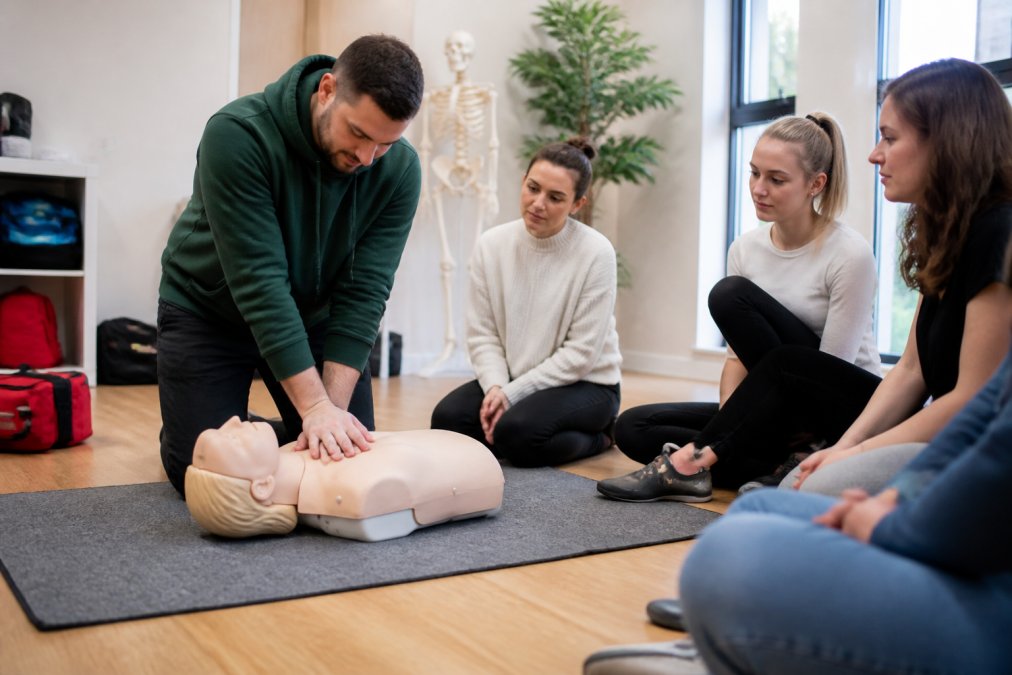
The instructor is the single most important variable in training quality. A qualified instructor models correct technique, corrects errors in real time, and builds confidence through deliberate practice.
Look for instructors with current PHECC instructor certification and, ideally, examiner status. PHECC examiners demonstrate mastery of content and assessment standards, evaluating whether learners perform CPR correctly under pressure. Specialised credentials like Manual Handling Instructor Level 6 QQI deepen expertise in workplace-specific risks.
Recency matters more than volume. Ask about the instructor's current teaching schedule and whether they maintain their own first aid certification through regular refresher training. Instructors who don't stay current can teach outdated protocols.
Instructors should demonstrate competency in practical assessment, identifying insufficient chest compression depth or misplaced airway manoeuvres. Request information about internal instructor evaluation; quality providers audit instructor performance regularly.
HSA First Aid Compliance for Employers: Legal Obligations
The Health and Safety Authority (HSA) mandates that employers provide adequate first aid facilities, equipment, and trained personnel appropriate to workplace risks.
"Adequate" is contextual. A small office requires different provision than a construction site or manufacturing plant. Conduct a risk assessment identifying potential injuries, then ensure first aid capacity matches those risks.
Practically, this means:
- At least one trained first aider must be present when staff are working
- For higher-risk environments, multiple trained staff reduce response time
- Training must be current, certificates typically expire every two to three years
- Records of training completion and certificate validity must be maintained
A certified first aid provider should help you understand your specific compliance obligations. They can review your workplace risk assessment and recommend appropriate training tiers. Some organisations need only general first aid; others require paediatric modules, sports-specific training, or advanced life support. HSA guidance on first aid in the workplace provides the regulatory framework, but a knowledgeable provider translates that framework into actionable training plans.
First Aid at Work Training Duration and Delivery Models
General First Aid courses typically span two to three days (16-20 hours). Paediatric First Aid requires additional hours for age-specific protocols. Refresher courses are shorter, often one day, focusing on skill maintenance.
Classroom instruction offers intensive, hands-on practice with immediate feedback. Blended learning combines online modules with in-person practical sessions, reducing time away from work. Each model has trade-offs.
Blended learning suits geographically dispersed staff or scheduling constraints. Learners complete theory independently, reducing classroom time. However, it requires disciplined self-study; unprepared learners make practical sessions remedial.
Classroom instruction builds team cohesion and ensures uniform pacing. For smaller organisations or rapid upskilling, classroom delivery often outperforms blended approaches.
A quality provider offers both options and recommends based on your staff size, locations, scheduling flexibility, and learning preferences.
Assessing Training Quality: Curriculum, Assessment, and Ongoing Support
Request a detailed course syllabus covering core competencies: CPR, choking, severe bleeding, shock, unconsciousness. Learners need multiple attempts at chest compressions, rescue breaths, and bandaging before muscle memory develops.
Assessment should be competency-based. Quality providers use structured rubrics evaluating technique against specific criteria: hand placement, compression depth, rate, recoil. Learners who don't meet standards receive remedial practice and reassessment.
Ongoing support distinguishes exceptional providers. Practical skills deteriorate significantly within 12 months without refresher training. A provider offering refresher sessions, online modules, or annual workshops maintains readiness.
Ask prospective providers about post-training support: refresher courses, online resources, and certificate expiry tracking. Certification is a starting point, not an endpoint.
Cost-Benefit Analysis: When In-Person, Blended, and Online Training Make Sense
Cost-benefit analysis requires comparing price against outcomes, not price alone.
For pricing details, please contact us directly or visit our website. The investment in quality training, whether in-person or blended, justifies itself through rapid readiness and effective emergency response.
The real question: what outcome does your organisation need? Rapid, confident response justifies classroom or blended training with strong practical components. Training 200 dispersed staff within budget may favour blended learning with strong refresher schedules.
| Delivery Model | Cost per Learner | Time Commitment | Practical Skill Retention | Best For |
|---|---|---|---|---|
| In-Person Classroom | €100-€150 | 2-3 days | High (80%+ at 6 months) | Small teams, rapid upskilling, high-risk environments |
| Blended Learning | €50-€100 | 1 day in-person + 4-6 hours online | Moderate (60-70% at 6 months) | Dispersed staff, flexible scheduling, larger cohorts |
| Online Only | €20-€50 | 4-6 hours | Low (theoretical only) | Not recommended for practical first aid |
Conclusion
Choosing a certified first aid provider is fundamentally about risk management. Accreditation, instructor qualifications, curriculum depth, assessment rigour, and ongoing support separate providers who meet minimum compliance from those who genuinely prepare your organisation for emergencies.
FIRST AID SAFELY combines PHECC accreditation with instructor expertise, flexible delivery, and post-training support. We align training to your specific risks and track certification renewals.
Get started with FIRST AID SAFELY and build a workplace culture where first aid readiness is standard practice, not an afterthought.
Real Customer Questions
We've been using another provider for two years, what makes your PHECC instructors actually better than what we're already getting?
The difference lies in ongoing expertise and workplace-specific tailoring.
Frequently Asked Questions
What qualifications should a first aid instructor have in Ireland?
A first aid instructor in Ireland should hold PHECC (Pre-Hospital Emergency Care Council) recognition as a minimum. Look for instructors with Level 6 QQI qualifications, current instructor certification, and evidence of ongoing professional development. They should be able to demonstrate competency evaluation skills and have experience delivering both theoretical knowledge and practical assessment. Verify their credentials directly with PHECC or request documentation of their accreditation status.
How do I verify if a first aid training provider is legitimate?
Check that the provider holds PHECC accreditation and ask for proof of their instructor qualifications. Verify their registration with relevant occupational health bodies and request references from previous corporate clients. A legitimate provider will openly share their certification standards, course syllabus, and assessment methods. They should also be transparent about their quality assurance processes and willing to provide training records documentation for compliance purposes.
What is the difference between PHECC-recognised training and other certifications?
PHECC-recognised training meets statutory requirements under Irish Health and Safety legislation and is aligned with occupational health standards. Other certifications may lack this regulatory standing and may not satisfy employer compliance obligations. PHECC training emphasises competency evaluation and practical skill assessment rather than theoretical knowledge alone. For workplace safety and legal compliance, PHECC recognition is the standard that employers and regulatory bodies expect.
How often must first aid training be refreshed for employees?
Most first aid certifications remain valid for three years, after which recertification is required. However, the Health and Safety Authority (HSA) recommends that organisations conduct training needs analysis annually to assess whether refresher training is needed before the certificate expires, particularly in high-risk workplaces. Some roles or workplace risk assessments may require more frequent updates. Your training provider should help you track validity periods and plan renewal schedules to maintain continuous compliance.
What should I look for in a first aid training provider for my specific workplace?
Select a provider who offers curriculum tailored to your workplace risks, manufacturing, healthcare, education, or sports settings each have different requirements. Verify their due diligence processes, ask about instructor-to-student ratios for practical assessment, and confirm they deliver training in a format that suits your staff (classroom, on-site, or blended learning). Request a training needs analysis to ensure the course content aligns with your risk assessment, and confirm they provide proper training records and certificates upon completion.
Can blended learning deliver the same competency as classroom instruction?
Blended learning combines online theory with practical classroom sessions, allowing flexible scheduling while maintaining hands-on skill assessment. Research shows that competency-based evaluation, not delivery format, determines effectiveness. The key is ensuring the provider includes sufficient practical assessment and instructor feedback. For organisations with multiple sites or stretched schedules, blended learning can be equally effective if the provider allocates adequate time for practical skills and maintains rigorous assessment standards.


Comments
Post a Comment