Sports First Aid Training for Coaches: A 2026 Guide
Table of Contents
- Step 1: Assess What Your Club Actually Needs
- Step 2: Choose the Right Sports First Aid Course
- How Long Is a Sports First Aid Course?
- Step 3: Build an Emergency Action Plan for Sports Clubs
- Step 4: Stock Your Pitch-Side First Aid Kit
- Step 5: Cover Duty of Care and Certification Renewals
- Common Mistakes Coaches Make After Training
- Frequently Asked Questions
Last Updated: October 4, 2026
Step 1: Assess What Your Club Actually Needs
Most clubs buy first aid training the way they buy insurance: quickly, and only after something goes wrong. That approach leaves gaps.
Research from ResearchGate's study on first aid qualifications among youth sport coaches found that only 19% of youth sport coaches held formal first aid training, while just 46% had any first aid knowledge at all.
Before booking anything, sit down and answer three questions:
- What ages do you coach? A GAA under-12 squad and a senior rugby panel carry different risks.
- What injuries happen most? Track your incident log for a full season before deciding.
- How far is your pitch from an ambulance? Rural grounds change your entire response plan.
Write the answers down. They'll shape every decision that follows, from course type to kit contents.
Step 2: Choose the Right Sports First Aid Course
The right course matches your sport, your players, and how your coaches actually learn. Generic workplace first aid covers the basics, but it won't prepare you for a suspected spinal injury on a wet pitch in November.
General First Aid vs Sports-Specific Training
General first aid teaches the fundamentals: bleeding control, airway management, and the recovery position. Sports-specific training builds on that foundation with concussion protocols, fracture stabilization, and soft tissue injuries. If your coaches supervise contact sport, the sports-specific route is the one to take. It covers sports trauma and immediate care in the environments where injuries actually happen.
Blended Learning vs Classroom Delivery
Blended courses now commonly combine one to two hours of online theory with 30 to 45 minutes of hands-on skills practice, according to Safety Training Seminars on blended learning models.
Classroom delivery still wins on one point. Online modules can't physically assess your technique. A qualified instructor can watch you perform CPR and correct your hand placement on the spot.
How Long Is a Sports First Aid Course?
A typical sports first aid course runs between four and six hours for the initial certification, though this varies by provider and course level.
Renewal matters just as much as the first certificate. The standard validity period for first aid and CPR certification is two years, per CPR and First Aid Training School.
For clubs with multiple coaches, stagger your renewals. If every certificate lapses in the same month, you'll be scrambling to cover training during your busiest season.
Step 3: Build an Emergency Action Plan for Sports Clubs
An emergency action plan is a written document that tells every coach, player, and volunteer exactly what to do when a serious injury happens.
Every plan needs five elements:
- Named first responders for each pitch or venue, with contact numbers posted publicly
- Venue address and Eircode for emergency services, including the exact pitch entrance
- Nearest AED location and who holds the key or code
- Evacuation route for ambulances, including gate access
- Incident reporting process covering who documents what, and when
Review the plan at the start of every season and after any incident. A plan nobody has read is worse than no plan, because it creates false confidence.
Step 4: Stock Your Pitch-Side First Aid Kit
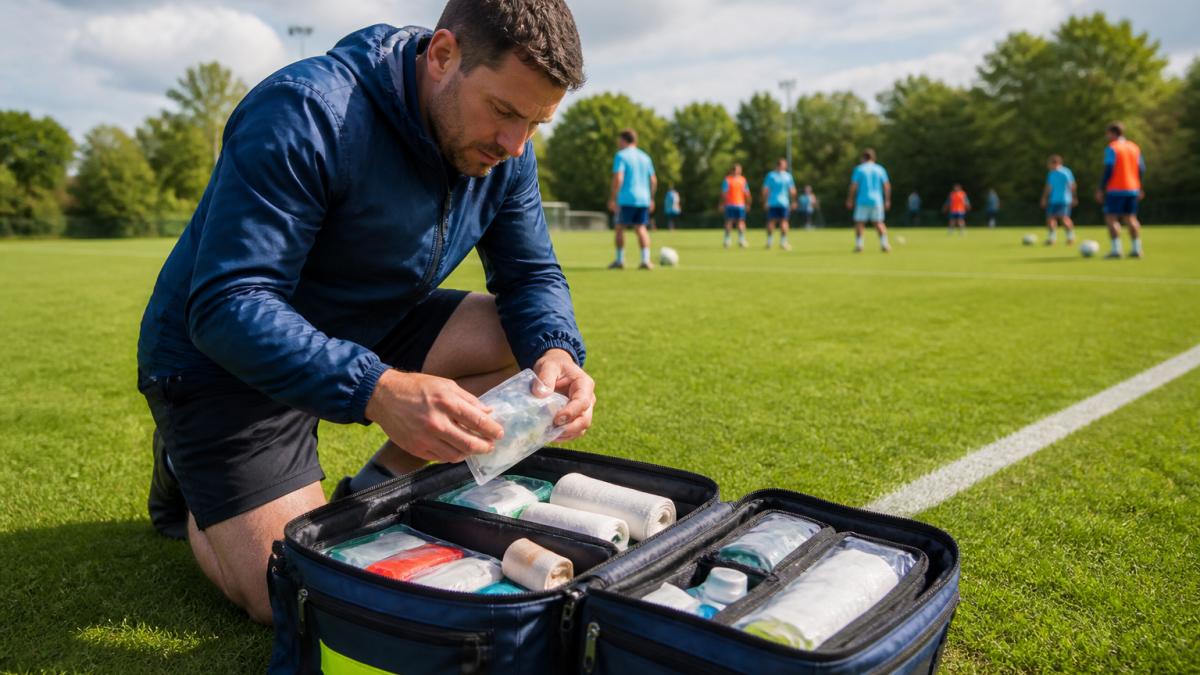
Your pitch-side kit should handle the first ten minutes of any injury, not the entire treatment. Stock it for bleeding control, immobilisation, and basic life support while you wait for an ambulance. What separates a kit that works from one that looks the part is whether it is matched to your sport, your age groups, and the number of players you supervise.
Core inventory every coach should carry
| Category | Items to Include | Quantity Guidance | Why It Matters |
|---|---|---|---|
| Bleeding control | Sterile dressings, conforming bandages, nitrile gloves, saline pods | 2-3 dressings per 15 players; gloves in at least two sizes | Controls external bleeding fast; saline irrigates grazes and turf burns |
| Airway and breathing | CPR face shield, resuscitation mask, disposable gloves | One shield per coach, plus one spare | Protects both coach and casualty during rescue breaths |
| Immobilisation | SAM splints, triangular bandages, instant cold packs, cohesive tape | Two splints, four triangular bandages, four cold packs | Stabilises suspected fractures and sprains before transport |
| Assessment | Digital thermometer, pen torch, blunt-nose scissors, trauma shears | One of each per kit | Supports triage, pupil checks, and cutting away kit without further injury |
| Documentation | Incident report forms, pen, permanent marker | 10 forms per kit | Meets safety compliance and supports insurance claims |
| Comfort and exposure | Foil blanket, spare fleece, glucose gel | One blanket, two gels | Treats shock and suspected hypoglycaemia pitch-side |
Match the kit to the sport
A GAA kit bag and a rugby kit bag should not be identical. Contact sports need more haemostatic and immobilisation stock; endurance sports need more hydration and cramp management; juvenile teams need paediatric-sized masks and smaller dressings.
- GAA and camogie: add extra cold packs and cohesive tape for hamstring and ankle injuries, plus a second foil blanket for sideline shock management.
- Rugby: add a haemostatic dressing, a second set of trauma shears, and a rigid cervical collar if your club has trained responders.
- Soccer and athletics: prioritise blister care, saline for turf burns, and a larger supply of instant cold packs.
Paediatric versus adult stock
This is the gap most club kits fall into. A paediatric resuscitation mask delivers a lower tidal volume than an adult mask, and a child's airway responds differently to positioning. If your club runs both underage and adult teams, carry both mask sizes and label them clearly. The same applies to cold packs, a full-size pack on a small child's limb can cause cold injury, so wrap it in a cloth or use a smaller pack.
Storage and restocking discipline
Check expiry dates monthly and restock after every use. Keep the kit pitch-side, not locked in a clubhouse cupboard. A simple pattern that works for most clubs is a laminated inventory card taped inside the lid, with a tick-box for each item and its expiry month. Whoever uses the kit signs the card, and the club safety officer restocks before the next fixture.
Step 5: Cover Duty of Care and Certification Renewals
Duty of care means you owe your players a reasonable standard of protection while they're under your supervision. In practice, that means trained coaches, a stocked kit, and a plan everyone understands. Insurance providers increasingly ask for evidence of all three, and a club that cannot produce them is exposed both legally and reputationally.
What duty of care actually requires
A reasonable standard is not a fixed checklist, but most practitioners and insurers converge on four elements:
- Competent supervision, at least one coach with current first aid certification present at every session and fixture.
- A documented plan, a written emergency action plan that every coach has read and can follow.
- Suitable equipment, a pitch-side kit matched to the sport and age group, checked and restocked.
- Accurate records, incident reports, training registers, and certification dates kept and retrievable.
Where a club runs underage teams, the standard is higher. Coaches working with children are typically expected to hold Garda vetting in addition to first aid certification, and clubs should keep evidence of both on file. Safeguarding and first aid are separate obligations, but they overlap in practice, a coach who cannot manage a distressed child after an injury is not meeting the full duty of care.
The return-to-play decision framework
This is the area most coaches get wrong, and it is where the biggest gap in current guidance sits. A player cleared for light training is not cleared for contact. Use a staged framework and document each step:
- Stage 1, Symptom-free at rest. No pain, no swelling, no concussion symptoms for at least 24 hours.
- Stage 2, Light aerobic activity. Walking, stationary cycling, or light jogging in a controlled setting.
- Stage 3, Sport-specific drills. No contact, no heading, no scrummaging.
Each stage should be separated by at least 24 hours, and any return of symptoms means dropping back a stage. For suspected concussion, the player should not return to play on the same day, and medical clearance should be sought before Stage 4. Document who cleared the player, when, and on what basis.
Psychological first aid is part of duty of care
A badly injured player needs calm reassurance as much as physical care. Coaches who acknowledge distress, explain what is happening, and stay with the player until help arrives reduce panic for everyone present. This matters most for young players, who may not have the language to describe pain or fear, and for long-term injuries where the emotional impact outlasts the physical one.
Practical steps that fit inside a normal training session:
- Kneel to the player's eye level and use their name.
- Explain each action before you do it.
- Keep other players back and give the injured player space.
Certification renewal without the scramble
Certification renewal is where clubs slip up most.
For clubs with multiple coaches, stagger your renewals. If every certificate lapses in the same month, you'll be scrambling to cover training during your busiest season.
FIRST AID SAFELY delivers courses led by a PHECC instructor and examiner, with certificates issued on completion and blended options for coaches spread across multiple sites.
Common Mistakes Coaches Make After Training
The biggest mistake is treating certification as the finish line. Training fades without practice, and skills you haven't used in eighteen months won't come back under pressure.
Watch for these three errors:
- No annual refresher. Run a 30-minute scenario drill each season using your own pitch and your own kit.
- Ignoring psychological first aid. A badly injured player needs calm reassurance as much as physical care. Coaches who acknowledge distress and communicate clearly reduce panic for everyone present.
- Skipping return-to-play protocols. A player cleared for light training isn't cleared for contact. Follow a staged return and document each step.
Safe sport education shapes how coaches handle these situations, though The Sport Journal's research on safe sport education notes that further study is needed to quantify its direct effect on injury outcomes. The direction of travel is clear even if the data is still catching up.
Frequently Asked Questions
Are sports coaches legally required to hold a first aid qualification?
There is no single law that names coaches specifically, but duty of care under Irish safety and health legislation applies to anyone running a sporting activity. Governing bodies and insurers usually go further, making a valid first aid certificate a condition of coaching. In practice, clubs treat certification as mandatory for anyone leading a session. Check your sport's governing body rules alongside your insurance policy before the season starts.
How often should sports coaches renew their first aid certification?
Two years is the standard validity period for first aid and CPR certification, so most coaches retrain on a two-year cycle. Some clubs ask for annual refreshers on CPR and AED use because those skills fade fastest without practice. Track expiry dates centrally for every coach rather than leaving it to individuals, and book renewals a month before they lapse so no one is sidelined mid-season.
What specific first aid skills are essential for sports coaches?
Coaches need CPR and automated external defibrillator use, bleeding control, fracture stabilisation, and recovery position for an unresponsive player. Concussion recognition, soft tissue injury management for sprains and strains, and heat-related illness care matter just as much pitch-side. Basic life support and airway management round out the core skill set. Training should include practical demonstration, not theory alone.
What is the difference between general first aid and sports-specific first aid?
General first aid covers workplace incidents: cuts, burns, choking, and basic life support. Sports-specific training adds the injuries coaches actually see, including concussion protocols, sprains and strains, fracture stabilisation, and return-to-play decisions. It also covers pitch-side emergency care and sudden cardiac events during exertion. If you coach, the sports version matches your reality far better than a generic workplace course.
Every club faces the same challenge: the moment an injury happens, your coaches are the first responders, and hesitation costs time you can't get back. FIRST AID SAFELY delivers sports first aid training for coaches through PHECC instructor-led sessions, blended learning options that fit around volunteer schedules, and certificates issued on completion. Get started with FIRST AID SAFELY and give your coaches the confidence to act when it counts.


Comments
Post a Comment