How do you verify first aid training certification?
Last Updated: October 25, 2026
Quick Summary
To verify first aid certification, scan the QR code on the certificate or enter the certificate number on the training provider's verification portal. The portal will display the holder's name, course type, issue and expiry dates, if these match the person presenting the certificate, it's valid.
- Most first aid certificates expire three years after issue with no grace period for expired certificates.
- Verify authenticity with the issuer, check current status in the portal, and match the course type to your specific requirement.
- Main accreditation bodies are PHECC and QQI, check their approved provider registers if you doubt recognition.
- Contact the training provider directly using details from their official website if the portal cannot find the certificate record.
- Keep a central record of provider name, certificate number and expiry date to track renewals and verify consistently.
Table of Contents
- Why verifying first aid certification matters
- How to verify first aid certificate online using QR codes and certificate numbers
- Check first aid certificate validity and current status
- First aid certificate expiry and renewal requirements
- How to check if a first aid training provider is recognised
- Verifying certificates issued by different training providers
- What to do if your certificate verification fails
- Confirming your first aid certification for employment or compliance
- Frequently Asked Questions
Why verifying first aid certification matters
Verifying first aid certification is essential for workplace safety, legal compliance, and genuine emergency readiness. A certificate without verification is just paper.
Employers face serious liability if they hire staff with fake or expired certifications, and schools and sports clubs must confirm teachers, coaches and volunteers can respond to medical emergencies.
At FIRST AID SAFELY, we work with organisations to ensure their teams hold valid, recognised qualifications, protecting your workplace, your reputation and the people in your care.
Most training providers now issue digital certificates with unique codes and QR codes, so you can check authenticity in minutes.
How to verify first aid certificate online using QR codes and certificate numbers
Here's how the process works:
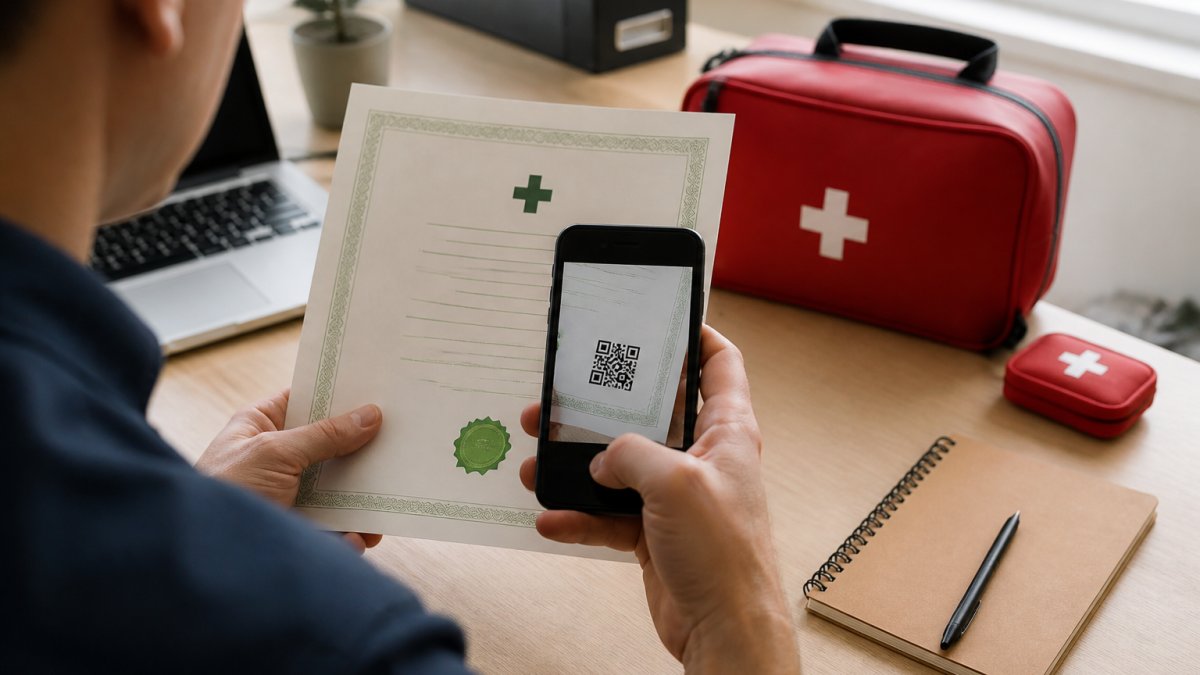
Using a QR code to scan and verify
Open your smartphone camera, point it at the code and tap the verification link to reach the provider's portal.
The portal shows the holder's name, course type, issue and expiry dates.
Watch out: photocopied certificates still scan but show the original issue date, not a renewal, always check the expiry date carefully.
Entering your certificate number or reference code
Looking up a certificate by participant name and email
Some verification systems let you search by name and email alone, useful when you have a CV or application form but no physical certificate.
Enter the person's full name and the email they registered with, and the system returns any certificates issued to that address.
This works well for employers screening applicants, schools checking teacher qualifications, or anyone who has lost their certificate.
Check first aid certificate validity and current status
A certificate can pass every authenticity check and still be unusable for the job in front of you.
Authenticity. The certificate was issued by the provider named on it, and the provider's records match the holder's name, course title, issue and expiry dates, what QR codes and certificate-number lookups confirm.
Validity (current status). The certificate has not expired or been withdrawn. Most first aid qualifications carry a three-year validity period, though the exact period is set by the awarding body and course type, always read the printed expiry date rather than assuming three years.
Recognition (fitness for purpose). The course is the right type and level for the holder's setting. A genuine, in-date basic workplace certificate may not satisfy a requirement for paediatric or defibrillator content, or a specific national standard.
To check all three in one pass, work through this sequence:
- Read the certificate. Note the course title, awarding or accrediting body, issue and expiry dates, the course title tells you what the holder was assessed on.
- Verify authenticity with the issuer. Use the QR code or certificate number as described above, and confirm the holder's name and dates match.
- Check current status. Confirm the portal shows the certificate as active and not revoked. If the portal's expiry date is earlier than the printed one, treat the portal as authoritative.
- Match the course to the requirement. Compare the course title and level against what the role needs. If your insurer, regulator or client contract specifies a course or standard, check against that rather than a generic 'first aid' label.
- Record the outcome. Note the verification date, method, who confirmed it, and the expiry date to diarise for renewal.
For employers, the practical test is not 'is this certificate real?' but 'would I be comfortable defending this certificate to my insurer, a client auditor or an inspector?'. If the answer depends on a course title you cannot match to the role, or an expiry date you have not diarised, the verification is incomplete even when the portal says 'valid'. First aid training evaluation research illustrates why refresher training matters for retained skills, which is the practical reason validity periods exist in the first place.
First aid certificate expiry and renewal requirements
First aid certificates typically expire three years after issue, ensuring holders keep their skills current as emergency techniques evolve.
Before expiry you can retake the full course or take a refresher, usually one or two days instead of three, covering essential skills plus protocol updates.
There's no grace period: an expired certificate cannot be used for employment, compliance audits or emergency response, even if renewed the day after.
First aid training evaluation research shows that participants who complete basic first aid training lasting 18 hours develop measurable skills.
We recommend tracking your certificate expiry dates in a central system, a spreadsheet or compliance software, with reminders three months before expiry so you have time to book a refresher.
First aid certificates follow standard expiry and renewal timelines to keep skills current.
| Aspect | Details | Note |
|---|---|---|
| Typical validity period | 3 years from issue date | Set by awarding body; always check printed expiry date |
| Renewal options | Full course or refresher | Refresher usually 1-2 days instead of 3 |
| Grace period | None | Expired certificate cannot be used for employment or compliance |
| Recommended action | Track expiry dates centrally | Set reminders 3 months before expiry to book renewal |
How to check if a first aid training provider is recognised
The main accreditation bodies are PHECC (Pre-Hospital Emergency Care Council) and QQI (Quality and Qualifications Ireland), look for their logos or mentions on the provider's website.
PHECC accredits providers delivering pre-hospital emergency care training to a national standard, while QQI recognises qualifications across multiple sectors.
You can also check if a training provider is recognised by searching the official PHECC or QQI registers, which list approved providers and authorised courses.
Watch out: some providers claim "internationally recognised" training without accreditation. The training may be fine, but it may not meet workplace or insurance standards, so confirm accreditation before enrolling or accepting a certificate.
Verifying certificates issued by different training providers
Most verification advice assumes the certificate came from the provider you already use. Each issuer runs its own system, and a genuine certificate can fail to appear in the portal you happen to be checking. Learn about the risks of uncertified training and why verification matters across different providers.
Step 1: Identify the issuer from the certificate itself. Read the document before searching any portal.
Step 2: Go to the issuer's own verification page. Search for the provider's name and look for a page titled 'verify a certificate', 'certificate validation' or similar. If you doubt authenticity, don't use a link printed only on the certificate, type the provider's main web address yourself.
Step 4: Contact the issuer directly when the portal fails. Use the contact details published on the provider's own website, not the phone number or email printed on the certificate.
Step 5: Escalate to the accreditation body only for recognition questions, not authenticity. PHECC and QQI do not run a public lookup for every certificate issued by every provider.
If your organisation trains across multiple providers, a central record of issuer, certificate number and expiry date lets you verify consistently rather than re-learning each provider's portal every time. Quality and Qualifications Ireland register of providers and Pre-Hospital Emergency Care Council approved institutions are the starting points for confirming that an issuer is approved to deliver the course named on the certificate.
What to do if your certificate verification fails
If a certificate doesn't verify, the QR code doesn't scan, the certificate number doesn't match, or the portal shows no record, you have a problem that needs investigating.
First, check the obvious: is the certificate number entered correctly, and is the name spelled exactly as on the certificate? Typos cause lookup failures, try again carefully.
If the provider can't find a record, the certificate may be fake, or the person trained with a different provider and is confused about which one issued it.
In employment or compliance situations, treat an unverifiable certificate as invalid rather than assuming a system error.
Confirming your first aid certification for employment or compliance
When you need to prove your own certification, for a job application, a compliance audit, or insurance purposes, you have several options.
The simplest is to provide your physical certificate, which employers and auditors can verify immediately using the QR code or certificate number.
Digital certificates are increasingly common and just as valid as physical ones, download, save and email yours to employers as needed.
Some organisations ask for your certificate number and consent to verify it directly with your training provider, the most secure method and becoming standard practice.
For workplace compliance, keep all your certifications in one place, provider name, course type, issue date, expiry date and certificate number, so you can provide the information immediately when your employer audits compliance.
If your certificate has expired, you cannot claim to hold a current qualification, even if you completed a renewal course. The new certificate's issue date is what counts.
To verify first aid certification protects everyone by confirming that responders actually have the skills to help in an emergency. At FIRST AID SAFELY, we issue certificates with full verification capability so your qualifications are always provable. Explore our certified courses and get training that meets Health and Safety standards.
Frequently Asked Questions
How can I verify my first aid certificate is legitimate?
Most training providers issue digital certificates with unique QR codes or reference numbers that can be scanned or entered into an online verification portal. Legitimate certificates display the training provider's name, course type, issue date, and expiry date. You can cross-check the provider's accreditation through their regulatory body. If the provider is PHECC-registered, you can confirm their approval status with PHECC. Always verify through the issuing organisation's official portal rather than third-party sites.
Can I verify a first aid certificate online if I've lost the physical copy?
Yes. Most training providers maintain digital records searchable by participant name, email address, or certificate number. Contact your training provider directly with proof of identity, and they can retrieve your certificate details or reissue a digital copy. Many providers now issue digital certificates automatically upon course completion, which you can access via email or a secure portal.
What should I do if my first aid certificate cannot be found online?
First, confirm you are using the correct training provider's verification portal, certificates issued by one provider cannot be verified through another's system. Check that you've entered your details accurately. If the certificate is several years old, it may have expired and been removed from active records. Contact the training provider's support team with your course completion date and participant name. They can search their archives and reissue a certificate if needed.
How long is a first aid certificate valid for, and when do I need to renew it?
Most first aid certificates are valid for three years from the issue date. Before expiry, you must complete a refresher course to maintain current certification. Some employers require annual verification of active certificates. Check your certificate's expiry date and plan your renewal at least four weeks before it expires to avoid gaps in compliance. Refresher courses are typically shorter than initial training and requalify you for the full three-year period.


Comments
Post a Comment