How to Book a PHECC Certified Training Course
Table of Contents
- Why Book a PHECC Certified Training Course
- How to Verify a PHECC Recognised Training Provider
- Understanding PHECC First Aid Responder Course Duration and Format
- Blended Learning First Aid Course Options
- PHECC Training for Workplaces: Group Booking and Compliance
- Step-by-Step Booking Process for PHECC Courses
- Step 1: Confirm the Qualification You Actually Need
- Step 2: Verify the Provider Before You Pay
- Step 3: Check Dates, Format, and Group Size
- Step 4: Understand the Fees, Payment Terms, and Cancellation Policy
- Step 5: Prepare Your Details and Documents
- Step 6: Book, Pay, and Confirm
- Step 7: Assessment, Certification, and Renewal
- Common Mistakes to Avoid When Booking PHECC Training
- Frequently Asked Questions
Last Updated: October 9, 2026
Why Book a PHECC Certified Training Course
When you book PHECC certified training course, you're investing in credentials employers recognise and regulators respect. PHECC (Pre-Hospital Emergency Care Council) sets Ireland's national standards for first aid and emergency response training, so a PHECC-recognised course meets legal requirements and industry expectations (Education and training standards - PHECC).
At FIRST AID SAFELY, we deliver PHECC-certified courses tailored to your needs, general first aid, paediatric, or sports-specific, in flexible formats that fit your schedule.
How to Verify a PHECC Recognised Training Provider
Most organisations slip up here: they assume any provider claiming PHECC approval is legitimate.
The safest way to verify is PHECC's official list of recognised institutions and courses.
Look for these markers of a legitimate PHECC-recognised provider:
- They appear on the PHECC recognised institutions and courses register
- Their instructors hold current PHECC instructor qualifications
- They can provide evidence of their recognition status without hesitation
When you book with FIRST AID SAFELY, this verification step is already done. We're a PHECC-recognised training provider with qualified instructors and examiners, so your certification arrives with full regulatory backing.
Understanding PHECC First Aid Responder Course Duration and Format
A PHECC First Aid Response (FAR) course is built around a defined number of instruction hours, commonly three days of classroom training. That covers patient assessment, emergency protocols, CPR and defibrillation, choking, bleeding and wound management, burns, fractures, medical emergencies, and scenario-based decision-making, followed by practical assessment.
What most course pages leave out is how your chosen format changes the experience, cost, and time out of work, worth understanding before you book.
Classroom Delivery
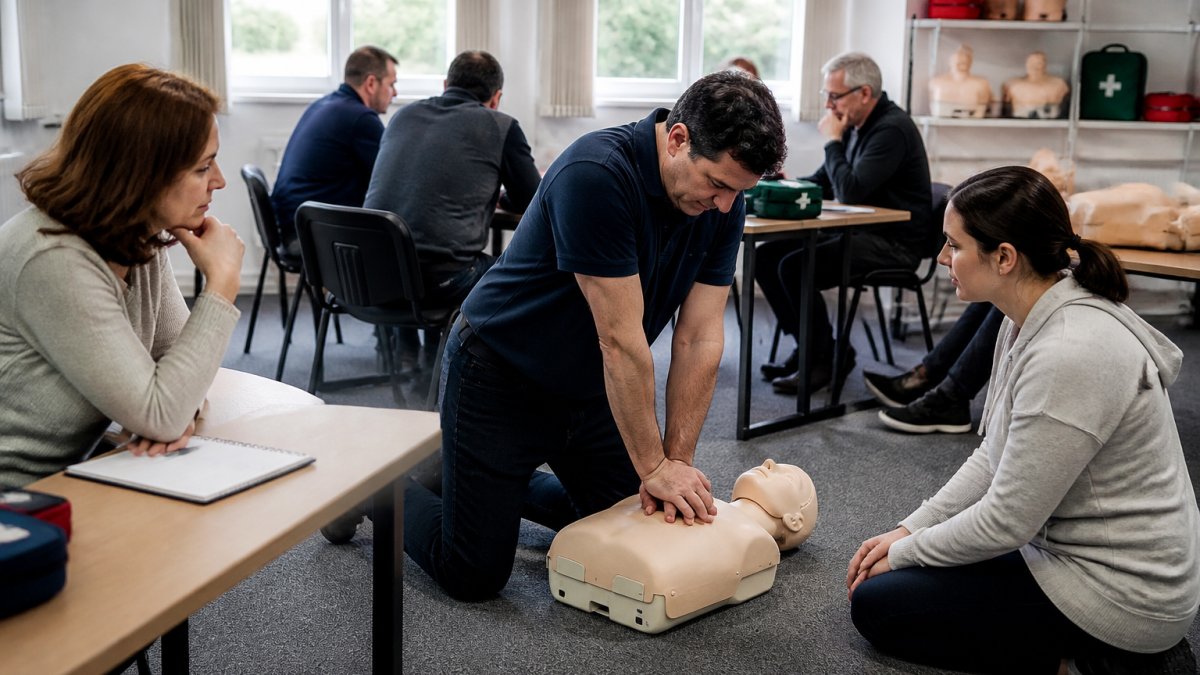
Instructor-led, in person, over consecutive days. You practise on manikins, work through scenarios with other learners, and get immediate correction, an instructor can adjust your hand position, compression depth, or bandaging technique in the moment.
The trade-off is release time: three full days away is a real cost, especially for small teams where every absence is felt.
Blended Learning
Blended delivery splits the course in two:
- Online theory, at your own pace before the practical block, covering protocols, patient assessment frameworks, and the reasoning behind each intervention.
- In-person practical and assessment, a shorter block, typically one to two days, focused entirely on hands-on skills and the formal assessment.
The practical benefit is scheduling: theory can be done in the evening or at a weekend, so time away from work is reduced to the in-person block only.
The trade-off is self-discipline: if the online component isn't completed before the practical block, you can't absorb it on the day, in-person time is for skills, not catching up on theory.
Weekend and Evening Intensives
Some providers run compressed or out-of-hours formats for learners who can't take weekday release. These suit individuals and small teams.
What the Assessment Actually Involves
Assessment covers both knowledge and practical competence, not a written exam alone:
- Practical demonstration, CPR, automated external defibrillator use, recovery position, and bleeding and choking management to the required standard.
- Knowledge check, questions covering the protocols and reasoning behind the interventions.
You're assessed against the standard, not other learners. Providers normally build in a retake opportunity if you don't meet the standard first time; confirm the terms at booking, because policies differ.
Certification Timeline and Validity
Once you complete the course and meet the assessment standard, you receive your PHECC certificate of course completion. Ask when it will be issued, some providers issue on the day, others post or email it shortly after.
Certificates are typically valid for two years, the single most important date to record, because a lapsed certificate is functionally the same as no certificate when an inspector or insurer asks.
Blended Learning First Aid Course Options
Blended learning has transformed how teams access PHECC training.
This works particularly well for larger organisations: staff across multiple sites or with unpredictable schedules complete the same content on their own timeline, so your workplace doesn't grind to a halt while your team trains.
The online component covers emergency protocols, patient assessment, and theory; the in-person element focuses on practical skills, CPR technique, recovery position, bandaging, and scenario-based decision-making.
FIRST AID SAFELY delivers blended learning designed for workplace teams: schedule flexibility plus the rigorous practical assessment that makes PHECC certification meaningful.
PHECC Training for Workplaces: Group Booking and Compliance
When you manage workplace health and safety, group training changes the booking conversation entirely: rather than sending one person to a public course, you're coordinating multiple staff across departments and shifts.
Group bookings let you schedule around your operational calendar rather than fixed public dates, build team confidence by training the whole cohort together, and often access volume pricing.
From a compliance perspective, group training documents that your team received formal, certified training, evidence regulators will look for if an incident occurs.
When arranging group training:
- Confirm participant numbers well in advance
- Identify accessibility or language needs
- Coordinate a date that minimises operational disruption
FIRST AID SAFELY designs training schedules around your operational needs, handles coordination, delivers at your location or ours, and provides certificates for every participant, giving your health and safety manager a complete record of who trained, when, and their certification status.
Step-by-Step Booking Process for PHECC Courses
Here is the full process, from deciding what you need to holding a certificate.
Step 1: Confirm the Qualification You Actually Need
PHECC qualifications aren't interchangeable, and booking the wrong one is the most common and expensive mistake. Work out which applies before you contact anyone:
- First Aid Response (FAR), the standard workplace and general-purpose qualification, and what most employers, schools, and sports clubs mean by "PHECC certification".
- Emergency First Response (EFR), a shorter, awareness-level course for where lower-tier cover is acceptable; it does not replace FAR for most workplace obligations.
- Cardiac First Response (CFR), community and responder-level CPR and defibrillation training, often alongside FAR or as a standalone module.
If your organisation has a written health and safety statement or regulator's requirement, read it before booking, it usually names the qualification and number of trained personnel required. If not, ask your provider to confirm in writing which course satisfies it.
Step 2: Verify the Provider Before You Pay
Do this before you enter card details, not after. Cross-check the provider against PHECC's own register of recognised institutions and courses at PHECC recognised institutions and courses register. Then confirm three things directly with the provider:
- The specific award the course leads to, and that it appears on the register.
- That instructors hold current PHECC instructor qualifications.
- That you'll receive a PHECC certificate of course completion, not an in-house attendance sheet.
If a provider can't produce recognition status on request, treat the booking as unverified. An unrecognised certificate won't satisfy an employer, insurer, or regulator, and you'll pay again to retrain.
Step 3: Check Dates, Format, and Group Size
Public courses fill fastest from September to November and in larger urban centres. With a compliance deadline, book four to six weeks ahead as a working rule, longer for a specific date or weekend slot.
Confirm the format in writing:
- Full classroom, typically three days for FAR.
- Blended learning, online theory plus a shorter in-person practical and assessment block.
- Weekend or evening intensive, where weekday release isn't possible.
Also ask how many learners will be in the room: smaller cohorts mean more hands-on repetition and individual feedback during practical assessment. There's no fixed regulatory maximum to assume, ask the provider directly.
Step 4: Understand the Fees, Payment Terms, and Cancellation Policy
Course fees vary by provider, format, and location, so treat any single figure as indicative. As a general pattern, blended learning uses fewer instructor hours, and group bookings can offer different rates than individual places.
Before committing, get answers in writing:
- What does the fee include, tuition, manual or materials, assessment, and certificate?
- Is a deposit required, and when is the balance due?
- Can your employer be invoiced, or must payment be by card at booking?
- What is the cancellation and rescheduling window, and is there a fee to move dates?
Step 5: Prepare Your Details and Documents
Have these ready before starting the online form, because most booking systems time out or lose progress:
- Full name exactly as it should appear on the certificate
- Contact email and mobile number
- Date of birth
- Employer or organisation name, if they're being invoiced
Most PHECC courses don't require prior first aid experience, and a common minimum age is 16, but confirm both with your provider. Bring photographic identification on the day.
Step 6: Book, Pay, and Confirm
Book online where offered, or by phone or email for group and invoiced bookings. You should receive a confirmation email with the course date, times, venue, what to bring, and any pre-course material.
For group bookings, nominate one point of contact who owns coordination, participant list, date changes, and payment, so three people don't each assume someone else confirmed the date.
Step 7: Assessment, Certification, and Renewal
Assessment is part practical demonstration and part knowledge check: you'll perform skills such as CPR and recovery position to the required standard and answer questions on the underlying protocols.
Once you pass, you receive your PHECC certificate of course completion. Certificates are typically valid for two years, so diarise the expiry date the day you receive it.
Common Mistakes to Avoid When Booking PHECC Training
The biggest mistake is booking with an unrecognised provider and discovering too late that the certificate won't be accepted.
Waiting until the last minute is another costly mistake: if courses are full, you'll miss your deadline.
Finally, some organisations book training but don't ensure staff attend or understand the material.
When you're ready to book PHECC certified training course, start by confirming your actual training needs and checking provider recognition.
Frequently Asked Questions
How do I verify that a training provider is PHECC recognised before booking?
Check PHECC's official list of recognised institutions and courses on their website. Only approved training institutions can deliver PHECC Responder Level courses leading to a certificate of course completion. Verify the provider's name, course type, and accreditation status before paying. A provider's claim of PHECC approval is not confirmation, always cross-check against the official register to ensure you're booking with an authorised institution.
What is the typical duration of a PHECC First Aid Responder course?
A PHECC First Aid Responder course has a defined duration. Some providers offer blended learning options that split content between online self-paced modules and in-person practical sessions, allowing flexibility for workplace schedules. The exact delivery format depends on your chosen provider and course type, so confirm the duration when you book.
Can I book a PHECC training course for my entire workplace team?
Yes. Many PHECC recognised providers offer group bookings for workplaces. Contact your chosen training centre directly to discuss group booking options, scheduling flexibility for multiple sites, and customised delivery options. Group bookings often allow you to schedule sessions at your location or arrange staggered attendance. Confirm cancellation policies, payment terms, and certificate timelines when booking for a group to ensure compliance with your renewal schedule.
What information and documents do I need to have ready before booking?
Have your full name, date of birth, contact details, workplace name, and role ready. If booking a group course, confirm participant numbers and any accessibility requirements. Check whether your chosen provider requires pre-course reading or prerequisites. Confirm payment method and whether you need an invoice for your organisation. Have your preferred course dates and location in mind, and clarify what happens if you need to cancel or reschedule before you complete payment.


Comments
Post a Comment