Is Online First Aid Training Valid? A 2026 Guide
Table of Contents
- Is Online First Aid Training Valid in Ireland?
- Online First Aid Course for Work: When It Meets the Bar
- Blended First Aid Training: The Practical Middle Ground
- Why a First Aid Practical Assessment Matters
- First Aid Certification Duration and Renewal Timelines
- How to Verify a Training Provider's Accreditation
- Conclusion: Choosing the Right Format for Your Organisation
- Frequently Asked Questions
Last Updated: October 12, 2026
Is Online First Aid Training Valid in Ireland?
Is online first aid training valid? It depends entirely on what the certificate is for. A purely online first aid course can build knowledge, but it rarely satisfies an employer, a regulator or an insurer that expects a trained first aider to prove practical competence.
The evidence on knowledge alone is reasonably encouraging. A review of first aid training effectiveness found that training programmes can improve participants' knowledge, skills and confidence, and Cochrane's review of first aid training for laypeople reported that first aid training likely improves knowledge, skills and self-efficacy in the month after training, though longer-term effects were unclear.
That is the crux. Online learning is valid as learning. Validity as a workplace qualification is a separate question, and it is the one that catches people out.
What Online Certificates Do and Do Not Qualify You to Do
An online first aid certificate is valid proof that you completed a course. It is not, on its own, proof that you can perform the physical skills.
What an online course typically does:
- Teaches the theory behind CPR, choking response and bleeding control
- Lets you learn at your own pace, on your own schedule
- Issues a course completion card, often with a stated validity period
What an online-only course does not do is let you demonstrate competence to an instructor. The American Red Cross guidance on online CPR certification states plainly that its entirely online CPR courses do not give learners the opportunity to demonstrate skill proficiency to a certified instructor, and therefore may not meet some requirements.
That gap matters most for first aid responder roles and any workplace where an employer or insurer expects hands-on competence.
Online First Aid Course for Work: When It Meets the Bar
For most workplaces, an online first aid course for work meets the bar only when it includes a practical element.
The reason is structural, not commercial. Under the Safety, Health and Welfare at Work Act 2005, every employer must ensure that a sufficient number of employees are trained to provide first aid, and the Health and Safety Authority guidance on first aid at work frames that duty around the number of trained persons, the hazards present and the size of the workplace, not around whether a certificate exists. The General Application Regulations 2007 then set out the minimum number of occupational first aiders a workplace must have based on headcount and risk level.
There is also a distinction that catches people out. In this jurisdiction, the recognised workplace qualification is the Occupational First Aid (OFA) award, delivered to a defined standard and assessed by a registered instructor.
So the honest answer to 'does it meet the bar?' depends on four things:
- What your risk assessment requires. Higher-risk environments, construction, manufacturing, agriculture, childcare, need people who can act, not just answer questions.
- What the regulations require for your headcount. The minimum number of trained first aiders scales with the number of employees on site at any one time.
- What your employer or insurer accepts. Many will accept a blended course with a practical assessment; fewer accept online-only completion cards.
- What the certificate actually states. A completion card is not the same as a recognised qualification, and an awareness certificate is not an OFA award.
If you are booking training purely to tick a box, online may look sufficient.
Awareness training versus workplace first aider qualification
These are two different products and they are routinely confused:
- Awareness or basic first aid training, suitable for general staff, covers recognising an emergency, calling for help, basic CPR theory and using an AED. Often deliverable online or blended. Does not make someone the designated workplace first aider.
- Occupational First Aid, the workplace qualification. Requires practical assessment by a registered instructor, covers the full range of workplace incidents, and is what the regulations contemplate when they refer to a trained first aider.
- CPR and AED training, a focused module that can be delivered online for theory but needs a manikin session for the practical component to be meaningful.
If your goal is to have a named, competent first aider on site, you are looking for the second category. If your goal is to raise general awareness across a team, the first category is fine, as long as nobody mistakes it for the second.
Blended First Aid Training: The Practical Middle Ground
Blended first aid training combines online theory with an in-person practical session, and for most organisations it is the format that satisfies both flexibility and competence.
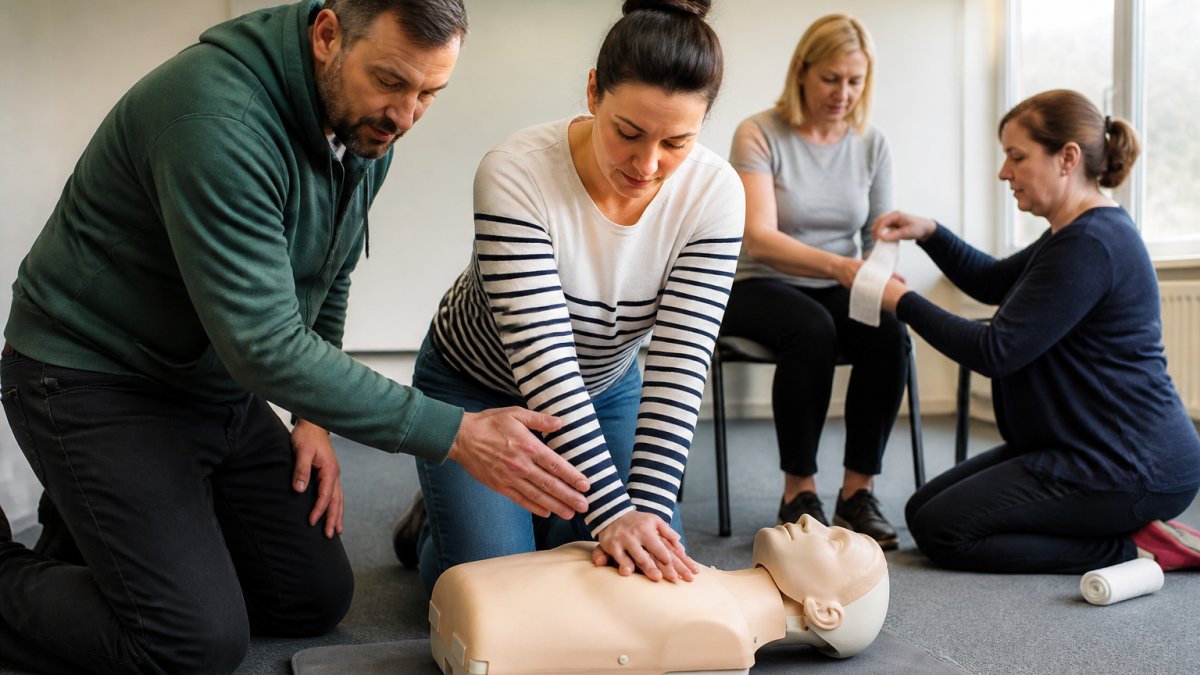
This is where we would point most clients. It respects the reality that staff are stretched across sites and shifts, while still producing a certificate holder who has demonstrated the skills.
| Format | Theory | Practical Assessment | Typical Fit |
|---|---|---|---|
| Online-only | Yes | No | Personal knowledge refresh |
| Blended | Yes | Yes | Most workplaces, schools, clubs |
| Classroom | Yes | Yes | Higher-risk and hands-on roles |
For teams spread across multiple locations, blended delivery means the online module can be completed anywhere, and the practical session can be scheduled in groups.
Why a First Aid Practical Assessment Matters
A first aid practical assessment matters because emergency response is a physical skill. Knowing the steps is not the same as being able to perform them under pressure.
The research points the same way. The American Red Cross survey on CPR confidence found that while most people recognise CPR and AED training as important, only a minority feel confident they could actually act.
A practical assessment confirms that a learner can:
- Deliver effective chest compressions at the right depth and rate
- Use an AED correctly
- Control bleeding and manage a choking casualty
- Follow emergency procedures in the right order
That is the difference between a course completion and genuine competence.
First Aid Certification Duration and Renewal Timelines
First aid certification duration varies by course and provider, but most workplace certificates run for two years, with some running to three.
The practical problem is not the length of validity. It is tracking it. Certificates expire quietly, and the first time many organisations notice is during an audit.
Refresher training also matters for skill retention. Cochrane's review noted that longer-term effects of training were unclear, which is a good argument for refreshing on schedule rather than waiting.
How to Verify a Training Provider's Accreditation
Verifying a training provider's accreditation takes minutes and prevents months of problems. The trick is knowing what to check, because 'accredited' is used loosely by providers and means different things in different contexts.
What 'accredited' actually means here
In this jurisdiction, the relevant recognition for workplace first aid training comes from a small number of places:
- The Health and Safety Authority (HSA) is the regulator for workplace safety. It does not 'accredit' individual first aid courses, but it does expect employers to be able to demonstrate that their first aiders are trained to an appropriate standard. HSA inspectors will ask for evidence of training and competence.
- The Pre-Hospital Emergency Care Council (PHECC) is the statutory regulator for pre-hospital emergency care. It sets the standards for recognised first aid responder and occupational first aid courses, approves training institutions, and maintains a register of recognised instructors. If a provider claims PHECC recognition, that claim is checkable.
- Quality and Qualifications Ireland (QQI) places awards on the National Framework of Qualifications. Some first aid awards sit on the framework; many short courses do not. A QQI placement is a useful signal but not a requirement for every workplace course.
- The Irish Heart Foundation delivers CPR and AED training to recognised standards and is widely accepted by employers and insurers for that specific module.
A provider that says 'fully accredited' without naming which of these applies is telling you nothing useful.
A verification checklist you can run before booking
- Name the awarding or recognising body. Ask the provider directly: which regulator or awarding body recognises this certificate? If the answer is vague, treat it as a red flag.
- Check the instructor. For a recognised occupational first aid course, the instructor should be registered with PHECC. Ask for the instructor's name and registration, and verify it against the PHECC register.
- Confirm the assessment method. Is the practical assessment conducted in person by a qualified instructor and examiner, or is it self-recorded video? Self-recorded skills checks are the weakest link in online first aid training and are not accepted for recognised workplace awards.
- Match the course to the requirement. Does the course title match what your risk assessment and headcount require, awareness, CPR/AED, or full Occupational First Aid?
- Check the certificate content. A valid certificate should name the learner, the course, the awarding or recognising body, the date of issue, the expiry date, and the instructor. If any of those are missing, it will be harder to defend at audit.
- Ask your insurer. Before booking, confirm in writing that your insurer accepts the specific course and provider. Insurers vary, and a claim is the wrong time to find out.
What to do if you have already bought an online-only certificate
If you have an online-only certificate and you are not sure whether it meets the bar, work through this order:
- Read the certificate carefully. Does it name a recognising body, or only the training company?
- Ask your employer or insurer whether they accept it for the role in question.
- If the answer is no, or you cannot get a clear answer, treat it as awareness training rather than a workplace qualification, and book a course with a practical assessment for anyone who needs to be the designated first aider.
Conclusion: Choosing the Right Format for Your Organisation
The right format comes down to what you need the certificate to do. If you want personal knowledge, an online first aid course is fine. If you need a trained first aider who can act in a workplace emergency, choose a format with a practical assessment, usually blended or classroom.
Frequently Asked Questions
Does an online first aid course count for workplace requirements?
It depends on the course and the employer's risk assessment. An online-only awareness module rarely satisfies workplace requirements because it lacks a hands-on practical assessment. A blended course that combines online theory with an in-person skills demonstration is more likely to be accepted. Always confirm with your employer or Health and Safety Manager before booking.
How long does first aid certification last?
First aid certification duration varies by course type and provider. Some certificates are valid for two years, others for three. After that, refresher training is needed to keep your qualification current. Employers should track renewal dates so certificates do not lapse between audits. Check the expiry date printed on your certificate and diarise a reminder well in advance.
Can you learn CPR effectively through an online course?
Online modules can teach the theory behind cardiopulmonary resuscitation, but they cannot confirm you can perform effective compressions at the right depth and rate. CPR skills require hands-on practice to build muscle memory. A blended approach, where you study online and then demonstrate skills in person, gives you both the knowledge and the practical competence employers expect.
How can I check whether a first aid course is recognised?
Ask the training provider which accrediting body or regulator recognises the course. In Ireland, courses delivered by a PHECC-approved instructor and examiner carry clear recognition. Check the provider's website for their accreditation details, and ask for the specific qualification your certificate will show. If the provider cannot name their accrediting body, treat that as a warning sign.
The challenge for most organisations is not choosing a format. It is keeping every certificate current across multiple sites and shifts. FIRST AID SAFELY delivers PHECC instructor and examiner led training, courses aligned with Irish Health and Safety legislation, and flexible blended learning options that fit around your team's schedule. Get started with FIRST AID SAFELY and keep your workplace genuinely prepared, not just compliant on paper.


Comments
Post a Comment