Is a SafetySquad Alternative Better for Corporate Training?
Last Updated: November 6, 2026
Quick Summary
A SafetySquad alternative for corporate training must satisfy Irish health and safety legislation, be delivered by a qualified instructor, and produce certification that holds up under inspection. Judge every option on accreditation, course coverage, delivery format and total cost, because a platform-issued completion record is not a certificate recognised by a regulator.
- Score each candidate out of five on instructor credential, course coverage, certification, renewal and administration fit.
- FIRST AID SAFELY is delivered by a PHECC instructor and examiner with Manual Handling Instructor Level 6 QQI qualification.
- A platform cannot observe CPR compression or correct airway position, so it complements certified instruction.
- Build cost comparisons from six line items, including certified instruction, administrative time and renewal costs.
- Certificates are provided upon completion, so confirm turnaround before booking to avoid audit gaps.
Table of Contents
- What a SafetySquad Alternative Must Get Right for Corporate Training
- SafetySquad vs Specialist First Aid Providers: Side-by-Side Comparison
- How to Choose a First Aid Training Provider Without Guesswork
- Why a PHECC Instructor for Private Training Changes the Outcome
- On-Site First Aid Training for Businesses: What to Expect on the Day
- First Aid Training Course Duration: How Long Each Format Takes
- Total Cost of Ownership: Platform Tools vs Instructor-Led Delivery
- Request a Corporate Training Quote for Your Workplace
- Frequently Asked Questions
What a SafetySquad Alternative Must Get Right for Corporate Training
A SafetySquad alternative for corporate training has to deliver more than a login and a certificate. It must satisfy Irish health and safety legislation, be delivered by a qualified instructor, and produce certification that holds up under inspection. Corporate first aid training should be judged against those three tests, because they reflect what a Health and Safety Authority inspector will look for.
The distinction matters more than most buyers realise. Platform-based training and instructor-led first aid training solve different problems, and confusing the two is the most common mistake we see when organisations switch providers.
Below, we set out how to compare options on accreditation, course coverage, delivery format and total cost, so you can choose with evidence rather than a sales pitch.
SafetySquad vs Specialist First Aid Providers: Side-by-Side Comparison
The two models differ in what they deliver. A platform-led provider supplies a system for tracking and delivering training content. A specialist first aid provider supplies certified instruction from a named, regulated professional. Most buyers searching for a SafetySquad alternative are not choosing between software and a course; they are trying to work out which combination of the two will satisfy an inspector. The comparison below is built around that question.
| Criterion | Platform-Led Model | Specialist First Aid Provider |
|---|---|---|
| Core offering | Training software and content library | Instructor-led certified first aid courses |
| Instructor credential | Often unspecified | PHECC instructor and examiner |
| Course coverage | Broad, generic catalogue | General, Paediatric and Sports First Aid |
| Delivery format | Online modules | On-site, classroom or blended learning |
| Certification | Platform-issued completion record | Certificate on completion |
| Renewal handling | Automated reminders, learner self-service | Provider-scheduled refresher, manual tracking |
| Multi-site administration | Central dashboard, role-based access | Per-site scheduling, regional instructor coverage |
| Reporting | Completion and progress exports | Attendance and assessment records |
| Best for | Record-keeping at scale | Compliance-critical practical training |
Neither model is automatically superior. The right choice depends on whether your obligation is to document training or to prove competence in an emergency.
A Criteria-Based Shortlist of Alternatives
Rather than name a single winner, score every candidate against the same five criteria and let the scores decide.
- Regulated instructor named in writing. The provider should name the instructor and their accreditation before you sign. A platform that cannot do this is a record-keeping tool, not a training provider.
- Course maps to your risk profile. Confirm the catalogue covers the actual hazards on your site, not a generic module list.
- Certification recognised by a body. Ask which organisation recognises the certificate and how it is verified after an incident.
- Renewal mechanism. Establish who tracks expiry dates and what happens if a learner lapses.
- Administration fit. Check whether the platform supports multi-site assignment, progress tracking and exportable reporting if you run more than one location.
Score each candidate out of five on each criterion. A platform-led option will typically score well on administration and poorly on instructor credential; a specialist provider will do the reverse. The shortlist only becomes useful when you weight the criteria to your own compliance context.
Where Platform Capabilities Actually Matter
Corporate buyers often assume a platform replaces a provider. It does not, but the administration features are real and worth assessing on their own terms. Look for course assignment by role or site, progress tracking at learner level, exportable completion reports, and automated renewal reminders. These features reduce the administrative time spent chasing certificates, which is a genuine cost. What they cannot do is observe a CPR compression or correct an airway position, so they complement rather than replace certified instruction.
Watch out: a platform-issued completion record is not the same as a certificate recognised by a regulator.
Where an organisation needs both, a blended approach usually works best: a certified provider for the practical first aid element, and a platform for tracking renewal dates.
How to Choose a First Aid Training Provider Without Guesswork
Choosing a provider comes down to verification, not reputation. Ask for credentials in writing, confirm the course maps to Irish legislative requirements, and check how certification is issued and renewed.
For a deeper walkthrough of the questions to put to any provider before you commit, see our guide on choosing a certified first aid provider.
Accreditation and Instructor Credentials to Verify
Ask three questions before signing anything. Who is teaching, what are their credentials, and which body recognises the certificate?
A legitimate provider will name the instructor and their accreditation without hesitation. FIRST AID SAFELY is delivered by a PHECC instructor and examiner, and includes Manual Handling Instructor Level 6 QQI qualification.
Watch out: the most common failure is booking a provider who cannot name a regulated instructor. If certification is challenged after an incident, an unaccredited course offers no defence. Our article on the risks of uncertified first aid training explains what can go wrong.
Course Coverage, Class Size and Certification Turnaround
Confirm the course matches your actual risk profile. A corporate office, a school and a sports club need different content, and a generic course serves none of them well.
Class size affects how much hands-on practice each participant gets. Ask for the maximum ratio before booking. Certification turnaround matters too: if certificates arrive weeks late, you may fail an audit in the gap. Certificates are provided upon completion.
Why a PHECC Instructor for Private Training Changes the Outcome
A PHECC instructor for private training can deliver first aid training in your own workplace, with the instructor qualified as a PHECC instructor and examiner.
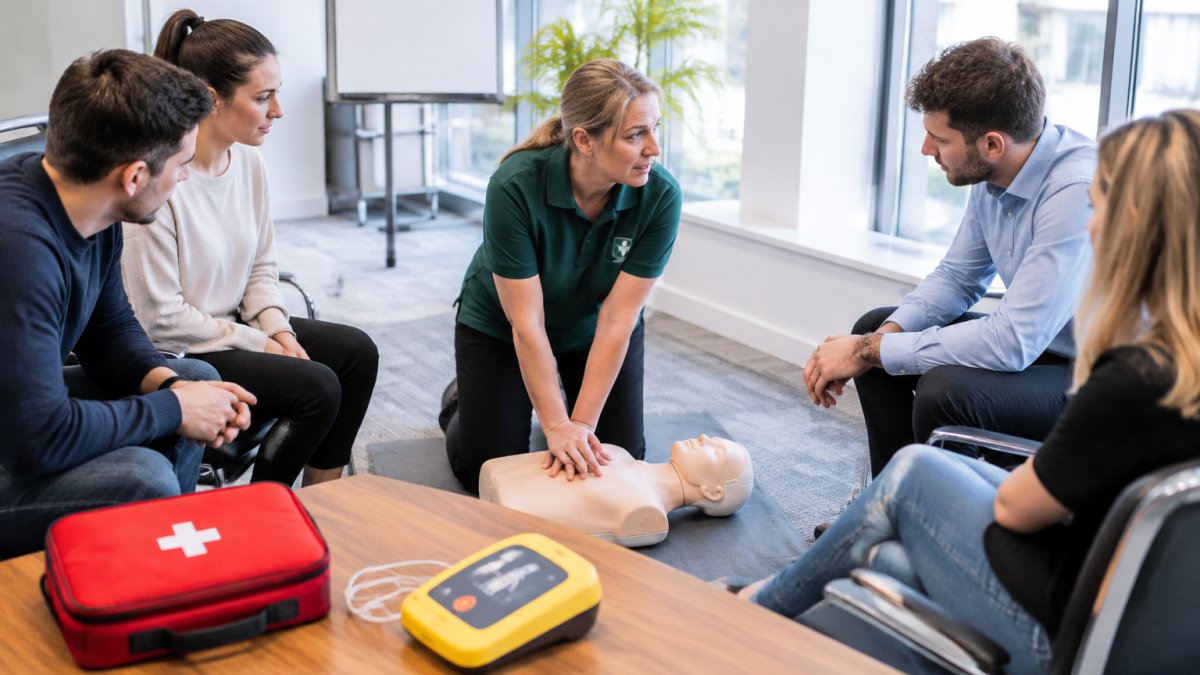
Physical first aid skills such as CPR compression depth, airway positioning and AED use are best practised with direct observation, which a video module cannot provide.
You can review the PHECC instructor and examiner credentials behind our courses to see what that accountability looks like in practice.
On-Site First Aid Training for Businesses: What to Expect on the Day
On-site first aid training for businesses runs in your own space, using your equipment and your layout.
First Aid Training Course Duration: How Long Each Format Takes
Course duration depends on the format and the level of certification required.
Delivery format drives the schedule more than course content does:
- On-site classroom: a single block, easiest for teams who can be released together
- Blended learning: theory completed independently, practical session scheduled separately
- Refresher training: shorter than initial certification, focused on renewal
If you are planning refresher delivery, the PHECC First Aid Response refresher course page sets out the format and what it covers.
Total Cost of Ownership: Platform Tools vs Instructor-Led Delivery
Total cost of ownership is where the comparison gets interesting. A platform subscription looks cheaper per head, but it does not discharge a practical training obligation on its own. The mistake buyers make is comparing a subscription line against a course fee and concluding the platform is cheaper. The two lines are not equivalent, and the comparison only becomes meaningful when both are counted.
The Line Items to Count
Build the comparison from the same categories on both sides:
- Subscription or licence fees. Platform pricing is usually per learner per year, sometimes tiered by seat count. Confirm whether lapsed learners are still billed.
- Certified instruction. The cost of the practical course itself, whether delivered on-site or at a training centre. This is the line a platform does not remove.
- Certification and assessment fees. Some providers charge separately for issuing certificates or for repeat assessment after a failed practical.
- Administrative time. The hours spent chasing renewals, reconciling attendance and preparing for audits. A platform reduces this; a manual process does not.
- Renewal and refresher costs. Certification expires, so the cost recurs. Establish the refresh cycle and whether refresher pricing differs from initial certification.
- Risk exposure. The cost of a certificate that does not hold up after an incident is not a line item, but it is the largest number in the comparison.
A Worked Structure, Not a Rate Card
Pricing depends on quantity, dates and delivery, so we recommend requesting a written quote from FIRST AID SAFELY for current prices.
When you request quotes, ask each provider to break the total into the six categories above. Putting both into the same six-line structure exposes the real difference.
Watch out: a low per-learner subscription figure can look cheaper than a course fee while leaving the practical training obligation unfunded.
Ask for a written quote and compare it against the fully loaded cost of your current arrangement. The number that matters is the total across the refresh cycle, not the first invoice.
Request a Corporate Training Quote for Your Workplace
A quote should tell you who is teaching, what certification participants receive, and how delivery fits your schedule.
If you are ready to move, you can contact First Aid Safely to discuss your requirements and request a quote for on-site corporate training.
The real test of any provider is whether the certification stands up when it is examined. If your current arrangement cannot answer that clearly, it is worth reviewing. FIRST AID SAFELY delivers PHECC instructor and examiner led training, courses aligned with Irish health and safety legislation, blended learning options for multi-site teams, and certificates on completion. Get started with FIRST AID SAFELY and put your compliance on a footing you can evidence.
Frequently Asked Questions
What are the alternatives to Safety Squad for corporate training?
Alternatives fall into two groups: digital platforms that host safety modules, and instructor-led providers who deliver accredited first aid, manual handling and fire safety courses on site. For compliance that holds up in an audit, look for a provider whose instructors hold PHECC recognition and whose courses map to Irish health and safety legislation. Ask for the instructor's credentials, the certificate issued on completion, and how renewal dates are tracked before you switch.
How do I choose a corporate training provider for first aid?
Start with accreditation: confirm the instructor is a recognised PHECC instructor and examiner, not just a trainer with a generic certificate. Then check course content against your risk assessment, class size, whether delivery is on site or blended, and how quickly certificates are issued. Ask how the provider handles refresher reminders, because expired certificates are a common audit finding. Compare at least two providers on those points rather than on headline price alone.
Can workplace first aid training be delivered on site?
Yes. On-site first aid training for businesses brings the instructor and equipment to your premises, so staff train in familiar surroundings and you avoid travel time across multiple sites.
What qualifications should a first aid instructor have?
In Ireland, a credible instructor should hold current PHECC recognition as an instructor and, where relevant, examiner status. For manual handling, look for a Level 6 QQI Manual Handling Instructor qualification. Ask to see evidence of both before booking, and check that the certificate your staff receive names the awarding body. A provider that cannot produce those credentials quickly is a risk to your compliance record.


Comments
Post a Comment