Paediatric First Aid Requirements for Schools: 2026 Guide
Table of Contents
- Legal Requirements for Paediatric First Aid in Schools
- What Is a Paediatric First Aid Certificate?
- PHECC Accredited Paediatric First Aid Course: What to Expect
- School First Aid Kit Contents List
- Paediatric First Aid Certification Validity and Renewal
- Emergency Response Protocols for Schools
- Special Educational Needs and Post-Incident Debriefing
- Frequently Asked Questions
Last Updated: September 23, 2026
Legal Requirements for Paediatric First Aid in Schools
Paediatric first aid requirements for schools in Ireland sit at the intersection of duty of care, staffing ratios and regulatory compliance. Under the Safety, Health and Welfare at Work Act 2005, every employer, including schools and early years providers, must ensure adequate first aid provision for staff, pupils and visitors.
Duty of Care and Regulatory Compliance
Duty of care is the legal obligation on a school to take reasonable steps to prevent foreseeable harm to those in its care. For paediatric settings, that obligation is heightened: young children cannot self-rescue, cannot reliably describe symptoms, and depend entirely on trained adults being present and ready.
Staffing Ratios and Availability Requirements
The number of trained paediatric first aiders a school needs depends on pupil numbers, age range, site layout and the nature of activities. Current industry guidance for early years and school settings recommends that at least one person holding a valid Paediatric First Aid qualification be present on site at all times, with additional trained staff to cover breaks, trips and split-site operations.
What Is a Paediatric First Aid Certificate?
A Paediatric First Aid (PFA) certificate is formal recognition that the holder has completed training in emergency care specifically for infants and children, covering CPR, choking, anaphylaxis, burns and other childhood-specific emergencies. It differs from a general first aid certificate in both the conditions covered and the techniques taught.
Difference Between Standard and Paediatric First Aid
Standard first aid at work training assumes adult physiology: adult CPR compression depth, adult choking manoeuvres, adult-sized equipment. Paediatric first aid reverses many of those assumptions. Compression depth, hand placement, and rescue breath ratios all change for infants and small children. A school that trains staff only in adult first aid is under-prepared for the emergencies most likely to occur on its premises.
Age Range Covered by Paediatric First Aid
Paediatric first aid typically covers children from birth to puberty, with techniques split into infant (under one year) and child categories. Schools and early years settings should confirm the age range covered by their chosen course matches the pupils they actually care for.
PHECC Accredited Paediatric First Aid Course: What to Expect
A PHECC accredited paediatric first aid course is delivered by a Pre-Hospital Emergency Care Council approved instructor and assessed against national clinical standards. PHECC is the statutory regulator for pre-hospital emergency care in Ireland, which means certification carries weight that unregulated online courses cannot match.
Course Curriculum and Learning Outcomes
A compliant paediatric course covers scene safety, primary survey, infant and child CPR, recovery position, choking management, anaphylaxis and auto-injector use, bleeding control, burns and scalds, and head injury recognition. Learning outcomes should be measurable: by the end, participants should be able to assess a scene, summon help, and deliver effective CPR without prompting.
In-Person vs Blended Learning Options
Blended learning combines online theory with a practical, in-person assessment. It suits schools with staff across multiple sites or staggered schedules, since the theory can be completed flexibly before a shorter practical session. In-person delivery remains the stronger option for teams new to first aid or those who want scenario practice built into the day.
School First Aid Kit Contents List
A school first aid kit should be stocked for the specific risks of an educational setting: playground falls, sports injuries, minor cuts, burns from science or home economics rooms, and allergic reactions. Guidance published in 2026 recommends that school kits include specific quantities of supplies, such as 2 triangular bandages, 6 safety pins, and 6 medium plus 2 large dressings, to meet low-risk requirements for educational settings, according to Steroplast's 2026 school safety preparedness guidance.
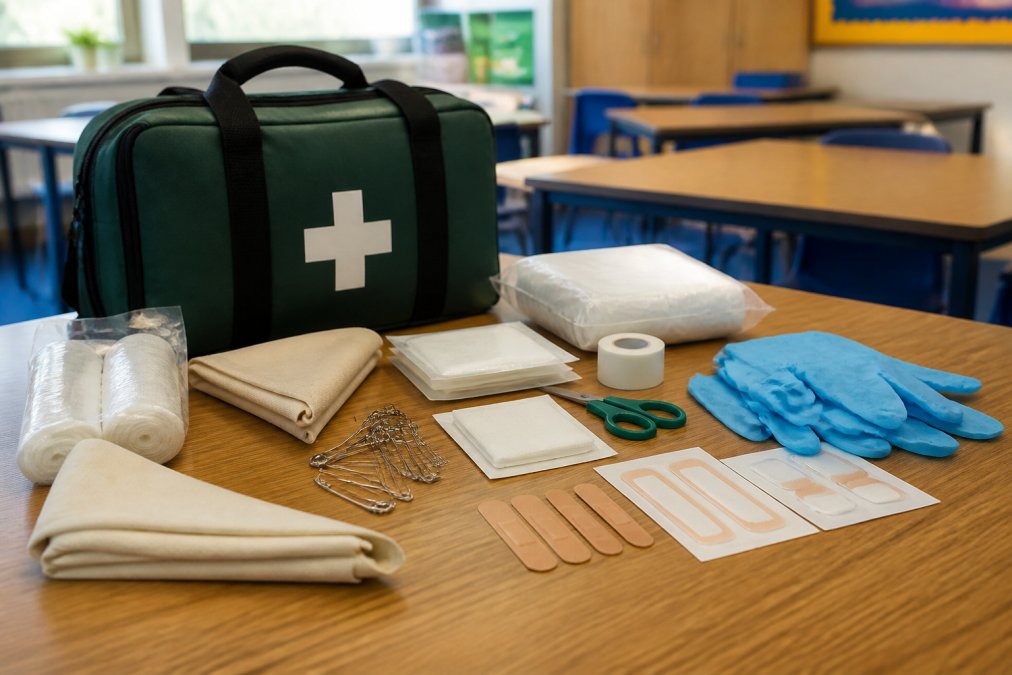
First Aid Kit Requirements for Educational Settings
- 2 triangular bandages
- 6 safety pins
- 6 medium and 2 large sterile dressings
- Assorted adhesive plasters
- Disposable gloves (multiple pairs)
- Sterile eye pads
- Burns dressing
- Foil blanket
- Scissors and tweezers
- Incident record book
Kits should be checked monthly, with a named staff member responsible for restocking.
Paediatric First Aid Certification Validity and Renewal
Paediatric first aid certification validity is typically three years from the date of assessment, after which the certificate lapses and the holder can no longer be counted as a trained first aider in staffing ratios. This is the single most common compliance failure in schools, and it is entirely avoidable with a simple renewal tracker.
How Often Should Paediatric First Aid Training Be Refreshed?
Full requalification every three years is the standard, but annual refresher sessions are strongly recommended to keep skills sharp. A common pattern in well-run schools is to schedule a two-hour refresher each September, covering CPR ratios, choking manoeuvres and auto-injector use, so that staff return from summer break with current technique rather than relying on recall from two or three years prior.
What Happens When a Certificate Lapses?
When a certificate lapses, the holder is no longer a qualified paediatric first aider in the eyes of the risk assessment. If a school's staffing model depends on that person being counted, the school is immediately non-compliant. The practical consequences are threefold: the risk assessment no longer reflects reality, the school may fall below its own minimum trained-person threshold, and any incident involving that staff member becomes harder to defend.
The most common audit failure is expired certificates. A school can have twelve trained staff on paper and zero compliant ones if every certificate lapsed in the same month. Track expiry dates in a shared calendar with 90-day reminders.
When booking requalification, ask the provider whether they issue a digital certificate with a verifiable reference number. This makes it faster to prove compliance during an inspection and reduces the risk of lost paper certificates.
Renewal Tracking Template
A simple spreadsheet with the following columns covers most schools' needs:
- Staff name
- Role
- Certificate type (Paediatric First Aid, Emergency First Aid, etc.)
- Awarding body
- Issue date
- Expiry date
- Refresher completed (Y/N)
- Notes (e.g., on leave, part-time, covering specific site)
Emergency Response Protocols for Schools
Every school needs a written emergency response protocol that any staff member can follow under pressure. The protocol should specify who calls emergency services, who begins CPR, who manages other pupils, and who meets the ambulance. Ambiguity costs seconds, and seconds matter.
CPR, Choking, and Anaphylaxis Management
CPR for children uses different compression depth and breath ratios than adult CPR, which is why paediatric-specific training is essential. Choking management follows a back-blow and abdominal-thrust sequence adjusted for age. Anaphylaxis management requires immediate auto-injector administration followed by a call to emergency services, with the pupil lying flat and monitored until help arrives.
Record-Keeping and Incident Reporting
Every first aid incident, however minor, should be recorded in a bound incident book or digital log capturing date, time, location, pupil name, nature of injury, treatment given, and staff member involved. These records protect the school legally and reveal patterns, such as repeated playground injuries at the same location, that feed back into the risk assessment.
Use a standard incident template with pre-printed fields. Staff under stress write incomplete notes; a structured form forces the details that matter in a claim or an inspection.
A workable incident template includes:
- Date and time of incident
- Exact location
- Pupil name and class
- Description of what happened
- Injuries observed
- First aid given (and by whom)
- Whether emergency services were called
- Whether parents/guardians were contacted
- Signature of the staff member completing the record
- Countersignature by the designated first aid coordinator
Post-Incident Debriefing for Staff
A staff member who performs CPR on a child carries that experience long after the ambulance leaves. Post-incident debriefing, ideally within 24 to 48 hours, gives staff a structured opportunity to process what happened, identify what worked and flag what needs changing.
A simple debriefing framework covers four questions:
- What happened, in sequence?
- What went well in the response?
- What was difficult or unclear?
- What will we change as a result?
Compliance is not just about having trained staff and stocked kits. It is about having a protocol that works under pressure, a record that stands up to scrutiny, and a debriefing process that turns every incident into a lesson. Those three elements separate a genuinely prepared school from one that merely holds certificates.
Special Educational Needs and Post-Incident Debriefing
Pupils with special educational needs may require individualised first aid planning, and staff who respond to a serious emergency need support afterwards. Both are routinely overlooked in compliance documentation, and both separate a genuinely prepared school from one that merely holds certificates.
SEN Considerations in Paediatric First Aid
Pupils with autism, sensory processing differences or communication difficulties may not report pain or symptoms in expected ways. Individual Healthcare Plans should note triggers, communication methods and any known medical conditions, and trained first aiders should be briefed on these plans before an incident occurs.
Supporting Staff After a Medical Emergency
A staff member who performs CPR on a child carries that experience long after the ambulance leaves. Post-incident debriefing, ideally within 24 to 48 hours, gives staff a structured opportunity to process what happened, identify what worked and flag what needs changing. The Paediatric First Aid Training in Practice case study documented by High Speed Training's case study on saving a child's life shows exactly why this matters: a trained staff member was able to intervene and save a child's life during an emergency at a soft play centre.
Frequently Asked Questions
What are the legal requirements for paediatric first aid in schools?
Schools must ensure at least one person with a current Level 3, 12-hour Paediatric First Aid certificate is on the premises at all times. Certain individuals must hold a valid qualification to be counted within official staff-to-child ratios. While first aid training is not universally mandated in all educational contexts, schools have a duty of care to provide adequate emergency response. Regulatory compliance means maintaining valid certificates and ensuring appropriate staff-to-child ratios are met throughout the school day.
What specific topics must be covered in a PHECC-accredited paediatric course?
A PHECC accredited paediatric first aid course covers scene safety, triage, resuscitation (CPR) for infants and children, choking hazards, anaphylaxis management, burns and scalds, and AED usage. The curriculum also includes incident reporting and emergency response protocols. Experiential and scenario-based instruction can improve recall and confidence. Courses typically run for 12 hours and are delivered by a qualified PHECC instructor and examiner, ensuring certification meets national standards for childcare providers and educational settings.
What items are mandatory in a school paediatric first aid kit?
A school first aid kit contents list should include items such as 2 triangular bandages, 6 safety pins, and 6 medium plus 2 large dressings to meet low-risk requirements for educational settings. Additional items often include plasters, sterile gauze, adhesive tape, scissors, gloves, and a resuscitation face shield. Kits must be regularly checked and restocked. Specific quantities depend on the number of pupils and whether the setting is early years or primary. Always follow current guidance for educational settings.
How often should paediatric first aid certification be renewed?
Paediatric first aid certification validity is typically three years, after which a refresher course is required to maintain compliance. Annual refresher training is recommended to keep skills current. Records must be kept for six years according to certification validity guidance. Schools should track renewal dates carefully to avoid lapses during audits. Blended learning options can make refresher training easier to schedule for staff across multiple sites. Always check with your training provider for specific renewal requirements.
How many staff members need to be trained in paediatric first aid?
The number of trained staff depends on staff-to-child ratios and the setting. At least one person with a current Paediatric First Aid qualification must be present on the premises at all times. For early years providers, certain individuals must hold a valid qualification to be counted within mandatory ratios. Schools should assess their specific needs based on pupil numbers, age groups, and risk assessments. Having multiple trained staff ensures cover during breaks, absences, and off-site activities.
What is the difference between paediatric first aid and standard first aid?
Paediatric first aid focuses specifically on infants and children, covering conditions and techniques relevant to younger age groups. Standard first aid at work training addresses adult emergencies. Paediatric courses include child-specific CPR ratios, choking hazards unique to small airways, and anaphylaxis management for children. The age range for paediatric first aid typically covers from birth to puberty. Schools need paediatric training because emergency response protocols differ significantly for children compared to adults.
Compliance is not a certificate on a wall; it is a system that stays current, documented and rehearsed. FIRST AID SAFELY delivers PHECC instructor and examiner-led paediatric first aid training, in compliance with Irish health and safety legislation, with flexible blended learning options for schools coordinating staff across multiple sites, plus certificates issued on completion. Get started with FIRST AID SAFELY and build a paediatric first aid programme that holds up under inspection.


Comments
Post a Comment